Circumcision and HIV in gay and bisexual men: trial results
The short version
In a randomized trial in eight Chinese cities, no men assigned to immediate circumcision got HIV within a year, compared with five men whose circumcision was delayed. The trial was small and short, and covered only men who mainly take the insertive role in anal sex.
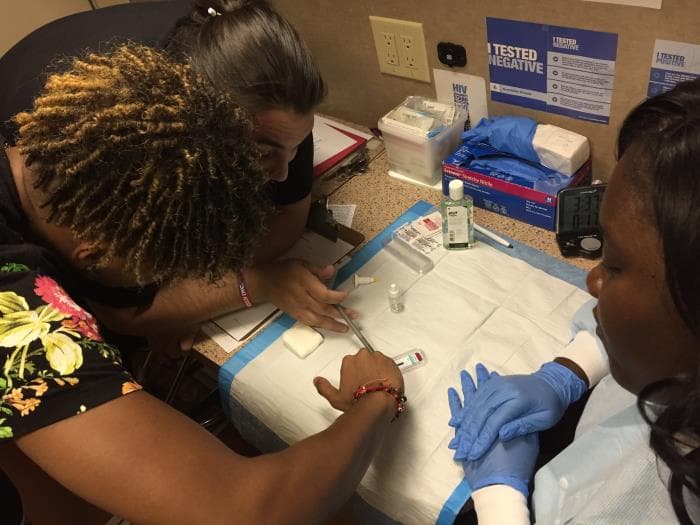
Photo: Gabrielle O'Meara, CDC (phil.cdc.gov)
What did researchers study?
A randomized trial published online May 28, 2024, in Annals of Internal Medicine tested whether voluntary medical male circumcision lowers new HIV infections in men who have sex with men. Researchers enrolled 247 uncircumcised, HIV-negative men aged 18 to 49 in eight cities in China. To join, men had to report mainly taking the insertive role in anal sex and having at least two male partners in the past six months.
Earlier randomized trials showed that circumcision lowers men's risk of getting HIV through sex with women (WHO). Whether it does the same for men who have sex with men was less clear.
How was the trial run?
Of the men, 124 were assigned to circumcision right away and 123 to circumcision after the study. Men were followed for up to 12 months and tested for HIV at the start and at 3, 6, 9 and 12 months. The researchers also asked about sexual behavior and tested for some other sexually transmitted infections. The main measure was HIV seroconversion: a man who tested negative at the start later testing positive.
What did the researchers find?
No HIV infections occurred in the immediate-circumcision group; five occurred in the delayed group. That is 0 infections per 100 person-years, compared with 4.1. The hazard ratio was 0.09, an estimated 91% lower rate of infection, but with a wide likely range (0.00 to 0.81) because there were so few infections. Rates of syphilis, herpes simplex virus type 2 and penile human papillomavirus did not differ significantly between the groups. The researchers found no evidence that circumcised men took more sexual risks.
How strong is the evidence?
Random assignment tends to make the two groups similar, which strengthens the result. But only five infections occurred in the whole trial, and follow-up lasted at most 12 months, so the size of the effect is uncertain. The results apply to men who mainly take the insertive role; the trial cannot show whether circumcision protects men who mainly take the receptive role.
How does this compare with WHO guidance?
WHO recommends voluntary medical male circumcision as an extra HIV-prevention option in places with widespread HIV spread through sex between men and women, alongside condoms, PrEP (HIV prevention medicine), antiretroviral treatment and post-exposure prophylaxis (WHO).
Its 2020 guideline, written before this trial, says circumcision "is not recommended to prevent HIV transmission in sex between men, as evidence is lacking that VMMC is protective during receptive anal intercourse" (WHO 2020).
What it means
This is randomized evidence that circumcision may lower HIV infection in men who mainly take the insertive role in anal sex. It rests on one small, one-year trial in China, and WHO guidance had not changed when the trial was published.
Original reports and sources (3)
- Gao Y, et al. "Efficacy of Voluntary Medical Male Circumcision to Prevent HIV Infection Among Men Who Have Sex With Men: A Randomized Controlled Trial." Annals of Internal Medicine, published online May 28, 2024; 177(6):719-728. https://doi.org/10.7326/M23-3317 (abstract: https://pubmed.ncbi.nlm.nih.gov/38801778/)
- World Health Organization. Preventing HIV Through Safe Voluntary Medical Male Circumcision for Adolescent Boys and Men in Generalized HIV Epidemics, 2020. https://www.ncbi.nlm.nih.gov/books/NBK562468/
- World Health Organization. Voluntary medical male circumcision. https://www.who.int/teams/global-hiv-hepatitis-and-stis-programmes/hiv/prevention/voluntary-medical-male-circumcision
See something wrong? Report an error · How we correct pages