Adult circumcision: recovery, pain, types and providers
 Medically reviewed by Dr Danish Gul, MBBS, Chief Resident in Urology and Kidney Transplant, PAF Hospital, IslamabadReviewed Nov 4, 2026
Short answer
Adult circumcision is surgery to remove the foreskin, the skin that covers the head of the penis.1–3 It is usually done with a numbing injection while you're awake, and you go home the same day.1–3 Swelling and a sensitive head are normal for 1 to 2 weeks, and full healing takes about 4 to 6 weeks.3–7 Men have it for medical, personal or religious reasons.1–3, 8
If you're considering circumcision as an adult, the questions below take you from the reasons, through the day itself, to full healing.
For babies and boys, see Circumcision in babies and children.
Start here

Photo: Vitaly Gariev / Unsplash
Key takeaways
- A tight foreskin that won't pull back (phimosis) is the most common medical reason adults have circumcision.1
- A tight foreskin that causes no problems may need no treatment, but doctors advise treating lichen sclerosus even when it doesn't hurt or itch.9, 21
- Acetaminophen (Tylenol) or ibuprofen is often enough once the numbing wears off, though some men are given a prescription painkiller.2, 4
- Providers advise waiting 4 to 6 weeks after adult circumcision before having sex or masturbating.1–4
- Heavy bleeding that doesn't stop with firm pressure needs the ER right away; a fever, spreading redness or pus needs a call to your provider.3–5, 11
At a glance
- What it is
- Surgery to remove the foreskin, usually same-day under local anesthetic
- Main reasons
- Tight foreskin, infections, frenulum tears; personal or religious reasons
- Who performs it
- Circumcision specialists, family doctors, general surgeons, mohels, urologists
- Main methods
- A surgical cut closed with stitches that dissolve on their own
- Healing
- Swelling 1 to 2 weeks; healed in about 4 to 6 weeks
- Start here
- Why men get circumcised as adults
Deciding

The day
Afterwards

Problems

More in this section


On this page
- Can you get circumcised as an adult?
- Why do men get circumcised as adults?
- Can a tight foreskin be treated without circumcision?
- Who does adult circumcision?
- What methods and styles of adult circumcision are there?
- Does adult circumcision hurt?
- How long does adult circumcision take to heal?
- What if you're unhappy with how your circumcision looks?
- How do you get circumcised as an adult, step by step?
- How much does adult circumcision cost?
- Is adult circumcision covered by insurance?
- What are the benefits and risks of adult circumcision?
- Does circumcision change sensation, sex or penis length?
Can you get circumcised as an adult?
Yes, adults can be circumcised, and it's usually a same-day procedure under a local anesthetic.1–3 It is done in a doctor's office, an outpatient clinic, a specialized circumcision clinic, a surgery center or a hospital.1, 3, 5, 11 What matters in any setting is a trained provider, sterilized instruments, and a plan for problems.
The operation itself usually takes about 20 to 30 minutes.7, 13 Ask your provider how long yours will take.
Read more: Why men get circumcised as adults
Why do men get circumcised as adults?
Men most often have circumcision as adults for a tight foreskin that won't pull back (phimosis), repeated infections or inflammation, or painful tearing during sex.1–3 Others choose it for personal, cultural or religious reasons, such as how it looks, hygiene, or converting to Judaism or Islam.1–3, 8, 23
Two of these problems have their own pages: Phimosis (tight foreskin) in adults and Torn or short frenulum (frenulum breve) in adults.
Read more: Why men get circumcised as adults
Can a tight foreskin be treated without circumcision?
Sometimes. It depends on the cause and on how much scarring there is. Options are listed from least to most invasive.
- Watch and wait: if a tight foreskin causes no problems, you may not need any treatment, but doctors advise treating lichen sclerosus even when it doesn't hurt or itch.9, 21
- Steroid cream: can soften a tight foreskin and ease symptoms for a while, but the tightness often comes back when the cream is stopped.6, 10
- Smaller operations: widening the foreskin (preputioplasty) has a limited role in adults. Lengthening a short frenulum (frenuloplasty) helps when the frenulum, not the foreskin, is the problem.6, 10
- Circumcision: the main treatment once lichen sclerosus, a skin condition that often causes a tight foreskin in adults, has scarred the foreskin, although a doctor may still try a strong steroid cream first.6, 10, 22
Read more: Phimosis (tight foreskin) in adults · Torn or short frenulum (frenulum breve) in adults
Who does adult circumcision?
Adult circumcisions are done by circumcision specialists, family doctors, general surgeons, mohels and urologists.1, 8, 12 On Circumpedia, a circumcision specialist means a provider whose main professional focus is circumcision, with dedicated training, extensive hands-on experience and routine performance of the procedure. Their skills cover first circumcisions, revisions and repairs, with attention to precision, function and the final cosmetic appearance. They assess patients, manage pain, oversee healing and follow-up, and recognize and manage complications. This is a practice focus, not a formal medical specialty. Not everyone in each group offers it, so ask any provider how many adult circumcisions they do.
A title or certificate alone doesn't show circumcision experience. How well it heals and how it turns out depend partly on the provider's skill and experience.12, 13
Read more: Who does adult circumcision?
What methods and styles of adult circumcision are there?
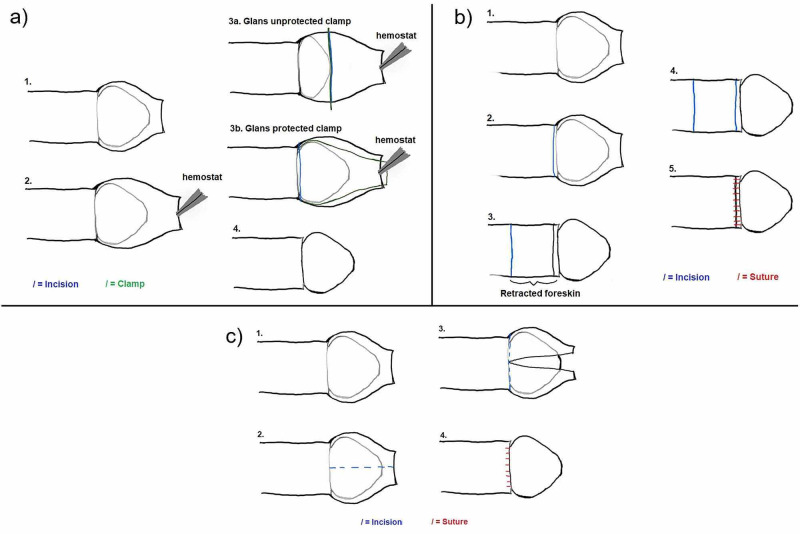
In a standard adult circumcision, the foreskin is removed and the edges are stitched together, with the stitches on the outside.7, 11 Some men have a preference about where the scar line sits, or how tight or loose the skin is; many don't mind. If you do, tell your provider.14
Ask any provider which kind of circumcision they do, whether you can choose the style, and how they close the wound.
In practice, a circumcision planned for how it looks (often called a cosmetic circumcision) takes longer than a basic one. In practice, before cutting, the provider plans where the line goes and how much skin to keep.25
Read more: Types of adult circumcision: methods and styles
Does adult circumcision hurt?
During adult circumcision, a local anesthetic is usually injected at the base of the penis, so you're awake but numb.1, 2, 4, 15 The injection is a brief prick; after that you shouldn't feel pain, though you may feel touching or pulling.1, 2, 4, 15
Some providers offer general anesthesia (being put to sleep), which can suit people who are very anxious or afraid of needles; many offer local only. It needs an anesthesia team and an operating room or surgery center, which adds cost and time, and it has its own side effects.1, 2, 4, 15
After the numbing wears off, acetaminophen (Tylenol) or ibuprofen is often enough; some men have more soreness and are given a prescription painkiller.2, 4
In practice, once the numbing wears off, many men feel mainly swelling and a very sensitive head.25
Read more: Does adult circumcision hurt?
How long does adult circumcision take to heal?
Adult circumcision usually takes about 4 to 6 weeks to heal fully.5–7 Swelling and bruising fade over 1 to 2 weeks.3 The stitches dissolve on their own in about 10 days to 3 weeks; sometimes they take longer.2, 3, 5, 11
You can go back to work when you feel comfortable, and heavy lifting should wait about 2 weeks.4, 11 Wait 4 to 6 weeks before sex or masturbation.1–4 Instructions differ between providers; follow your own provider's.
In practice, the cut itself usually closes in about 2 weeks. In practice, desk work is often possible after 2 to 3 days, and physical work after about 5 to 7 days.25
Read more: Healing after adult circumcision
What if you're unhappy with how your circumcision looks?
Give it time: the look keeps improving for a few months after the wound has healed.5, 6 Being unhappy with how it looks is one of the problems reported most often after circumcision.16
If a problem remains once everything has settled, see Circumcision revision in adults. It explains which problems a second operation can correct, how long to wait, and who does revisions.
Read more: Circumcision revision in adults
More questions
How do you get circumcised as an adult, step by step?
Getting circumcised as an adult usually means one visit to plan, a same-day operation, and about 4 to 6 weeks of healing.1–3, 5–7
- Book a first visit. Talk through your reason, the options, the style you want and the pain relief. The questions to ask, below, can help.
- Check your insurance, if the reason is medical. The provider may need your insurer's approval in advance; ask how long the answer usually takes.17, 18
- Have the operation. After a numbing injection, the operation itself usually takes about 20 to 30 minutes, and you go home the same day.1–3, 7, 13
- Rest for the first days. Swelling and a sensitive head are normal. Go back to work when you feel comfortable.3–5
- Avoid heavy lifting for about 2 weeks, while swelling and bruising fade.3, 4, 11
- Wait 4 to 6 weeks before sex or masturbation.1–4
How much does adult circumcision cost?
Adult circumcision prices vary between providers, and we don't list them. Being put to sleep (general anesthesia) adds to the cost.1, 2, 4, 15 Ask what the price includes:
- Are follow-up visits included?
- Who do I call with questions after the procedure, including at night?
- Can I reach the person who did my circumcision directly?
Swelling and bruising are normal, but they can be worrying, so being able to ask matters.
Is adult circumcision covered by insurance?
Insurance usually pays for adult circumcision only when there's a medical reason, often only after approval in advance (preauthorization). Approval isn't a promise to pay.17, 18 It works like this:
- Ask the provider whether they take your insurance.
- Send them your insurance details if they do. They ask your insurer for approval, sometimes with your medical records.
- Wait for the answer. Ask the provider how long it usually takes.
- Check what you'll still owe. Even if it's approved, you may still pay part of the cost yourself: your deductible, copays or coinsurance, depending on your plan.19
For personal or cosmetic reasons, you usually pay yourself.18
What are the benefits and risks of adult circumcision?
Adult circumcision can treat several foreskin problems, and like any operation it carries risks. In brief:
- Possible benefits: circumcision is the main treatment once lichen sclerosus has scarred the foreskin.10 In trials in Africa, circumcision lowered men's risk of getting HIV, and some other sexually transmitted infections, from vaginal sex, but did not remove it. It hasn't been shown to lower the risk for the receptive partner in anal sex.16
- Possible risks: the problems reported most often are pain, bleeding, infection and being unhappy with how it looks. Others include swelling and a collection of blood under the skin. Problems with the anesthetic are rare.1, 3, 16 A lasting change in the feeling of the head of the penis is common (see the next question).6
Each benefit and risk, with what the studies show: Adult circumcision benefits and risks.
More on the HIV evidence, and on condoms and PrEP: Why men get circumcised as adults.
Does circumcision change sensation, sex or penis length?
A lasting change in the feeling of the head of the penis is common; UK urologists describe it as altered or reduced. Most studies, however, don't show less sexual pleasure or satisfaction.2, 6, 16
The head of the penis is very sensitive for up to about 2 weeks.2, 6 On average, men circumcised as adults report little or no change in sexual satisfaction or function.16 Men who enjoy the feel of the foreskin during sex lose that sensation.16 Erections continue as normal; at first there may be some tightness around the scar.6 Circumcision doesn't shorten the penis.2 If too much shaft skin is removed, the penis can look shorter; see Circumcision revision in adults.12
When to call
Call 911 now
- After circumcision: heavy bleeding that doesn't stop with firm pressure, or you feel faint or seriously unwell. Go to the ER right away.3, 11
- If you're not circumcised: your foreskin is stuck behind the head of the penis, the head swells, and the foreskin won't come forward again (paraphimosis). This is an emergency: go to the ER right away.1, 6, 9, 10
- You can't urinate at all, or your lower belly feels painfully full and you can't empty your bladder: go to the ER.20, 24
Call your provider today
- After circumcision: if the head of the penis is numb, very pale or looks blue, the dressing may be too tight. Take it off at once and put it back on more loosely, then call your provider. If the color doesn't come back within a few minutes, or you can't reach your provider, go to an emergency room.4
- After circumcision: bleeding that doesn't stop after 5 to 15 minutes of firm pressure.11
- After circumcision: a fever or chills (providers give 100.4°F (38°C) or 101°F as the line).3–5
- After circumcision: spreading redness, warmth or swelling, pus, a bad smell, or the wound opening.3–5
- After circumcision: pain your painkillers don't control.3, 5
- You can't urinate within about 8 hours of going home.20
Questions to ask your provider
- How many adult circumcisions have you done, and how many do you do a month?
- Which method do you use, and can I choose the style: where the line goes, tighter or looser?
- How do you close the wound, and what will the scar look like?
- Will I be awake with a local anesthetic, or put to sleep?
- Who do I call with questions afterward, including at night?
- Are follow-up visits included in the price?
The bottom line
Adult circumcision is usually a same-day operation under a local anesthetic, followed by about 4 to 6 weeks of healing. Providers differ in experience, in how carefully they plan the result and close the wound, and in whether you can reach them afterward. Asking each provider the same questions lets you compare their answers.
Latest news
This section's medical reviewers

Sources (25)
- Holman JR, Stuessi KA. "Adult Circumcision." American Family Physician (American Academy of Family Physicians), Mar 15, 1999;59(6):1514-1518. https://www.aafp.org/pubs/afp/issues/1999/0315/p1514.html (accessed Oct 26, 2026)
- University of Utah Health. "Circumcision as an adult, circumcised vs uncircumcised, phimosis and paraphimosis treatment." Published Apr 6, 2021, updated Sep 15, 2026. https://healthcare.utah.edu/mens-health/treatments/circumcision-frenulotomy (accessed Oct 26, 2026)
- Society of Urologic Nurses and Associates (SUNA). "Circumcision" patient handout. 2022. https://www.suna.org/sites/default/files/download/resources/SUNA_circumcision.pdf (accessed Oct 22, 2026)
- UW Medicine. "After Your Surgery: Adult circumcision." 2011, clinician review Aug 2013. https://honline.s.uw.edu/sites/default/files/record_pdfs/After-Your-Surgery-Adult-circumcision.pdf (accessed Oct 26, 2026)
- Salem Health Urology. "Adult circumcision postoperative instructions." Undated. https://www.salemhealth.org/docs/default-source/urology/post-op-instruction-sheets/adultcircumcision_postop_120924.pdf (accessed Oct 22, 2026)
- British Association of Urological Surgeons (BAUS). "Complete removal of the foreskin (circumcision)," patient leaflet A24/077. June 2024 (review due Sep 2026). https://www.baus.org.uk/_userfiles/pages/files/Patients/Leaflets/Circumcision.pdf (accessed Oct 26, 2026)
- NHS (England). "Circumcision in men." Reviewed Mar 11, 2026. https://www.nhs.uk/conditions/circumcision-in-men/ (also served at https://www.nhs.uk/tests-and-treatments/circumcision/) (accessed Oct 26, 2026)
- My Jewish Learning. "The Covenant of Circumcision" (A. Diamant). Modified May 13, 2022. https://www.myjewishlearning.com/article/the-covenant-of-circumcision/ (accessed Oct 22, 2026)
- NHS (England). "Tight foreskin (phimosis)." Reviewed Mar 6, 2026. https://www.nhs.uk/conditions/phimosis/ (accessed Oct 26, 2026)
- British Association of Urological Surgeons (BAUS). "Tight foreskin (phimosis)." March 2024 (review due Aug 2026). https://www.baus.org.uk/patients/conditions/13/tight_foreskin_phimosis/ (accessed Oct 26, 2026)
- Naval Medical Center Portsmouth (US Navy), Urology Clinic. "Adult Circumcision Information Sheet." Updated Nov 4, 2011. https://portsmouth.tricare.mil/Portals/130/AdultCircumcision.pdf (accessed Oct 26, 2026)
- Warees MW, Anand S, Leslie SW, Rodriguez AM. "Circumcision." StatPearls (NCBI Bookshelf, US National Library of Medicine). Updated May 2, 2024. https://www.ncbi.nlm.nih.gov/books/NBK535436/ (accessed Oct 26, 2026)
- World Health Organization and Jhpiego. "Manual for male circumcision under local anaesthesia and HIV prevention services for adolescent boys and men," chapter 9. Apr 19, 2018. https://hivpreventioncoalition.unaids.org/sites/default/files/attachments/MC_manual_2018_chapter_9.pdf (accessed Oct 26, 2026)
- Callegari M, Muncey W, Kim T, Rhodes S, Woo L, Hannick J. "Where to draw the line? Understanding preferences in mucosal collar length after circumcision." Canadian Urological Association Journal 2022;16(9):E473-8 (a survey of the US public). https://cuaj.ca/index.php/journal/article/view/7691 (accessed Oct 22, 2026)
- Anesthesia Patient Safety Foundation (APSF). "What are the side effects of anesthesia?" (Patient Guide). Modified Apr 27, 2025. https://apsf.org/patient-guide/what-are-the-side-effects-of-anesthesia (accessed Oct 22, 2026)
- US Centers for Disease Control and Prevention (CDC). "Information for Providers to Share with Male Patients and Parents Regarding Male Circumcision and the Prevention of HIV Infection, Sexually Transmitted Infections, and other Health Outcomes." Aug 22, 2018. https://stacks.cdc.gov/view/cdc/58456 (accessed Oct 26, 2026)
- HealthCare.gov (US Centers for Medicare & Medicaid Services). "Preauthorization" (glossary). https://www.healthcare.gov/glossary/preauthorization (accessed Oct 22, 2026)
- US health plans' coverage policies on circumcision (examples; no insurer is named on the page): Cigna Medical Coverage Policy 0582 (effective May 15, 2026); Mississippi Medicaid, 23 Miss. Code R. 203-4.12 (accessed Oct 22, 2026)
- HealthCare.gov (US Centers for Medicare & Medicaid Services). "Deductible" (glossary). https://healthcare.gov/glossary/deductible (accessed Oct 22, 2026)
- AORN / Outpatient Surgery Magazine. "What Do You Know About Post-Op Urinary Retention?" Nov 2011. https://aorn.org/outpatient-surgery/article/2011-November-what-do-you-know-about-post-op-urinary-retention (accessed Oct 22, 2026)
- National Institute of Arthritis and Musculoskeletal and Skin Diseases (NIAMS, NIH). "Lichen sclerosus." Undated. https://www.niams.nih.gov/health-topics/lichen-sclerosus (accessed Oct 22, 2026)
- McPhee AS, Stormont G, McKay AC. "Phimosis." StatPearls (NCBI Bookshelf). Updated Aug 8, 2023. https://www.ncbi.nlm.nih.gov/books/NBK525972/ (accessed Oct 22, 2026)
- Dar al-Ifta al-Misriyyah (Egypt). Fatwa 5940, "Is it obligatory for adult male converts to be circumcised when they embrace Islam?" Jul 24, 2013. https://dar-alifta.org/en/fatwa/details/5940/is-it-obligatory-for-adult-male-converts-to-be-circumcised-when-they-embrace-isla (accessed Oct 26, 2026)
- Reviewer statements for Circumpedia: Dr Danish Gul, Nov 2, 2026; Dr Mazen Abu Alnasr (second doctor's check), Oct 29, 2026.
- Practical experience of a circumcision specialist
See something wrong? Report an error · How we correct pages · How we make our pages