Adult circumcision types: methods and styles compared
 Medically reviewed by Dr Mazen Abu Alnasr, MD, General Surgeon (Saudi Board of General Surgery)Reviewed Oct 30, 2026
Short answer
Adult circumcision is usually done with a scalpel or scissors, and the skin edges are stitched.2, 5 A WHO manual describes three surgical methods (dorsal slit, forceps-guided and sleeve resection), which differ in how the cut is made.2 Devices such as the ShangRing are used mainly in HIV-prevention programs in Africa.3 The authors of a US survey advise surgeons to discuss the look with patients beforehand.4
If you're comparing methods or thinking about the look, below are the methods side by side, what the style words mean, and questions to ask.
For babies, see Newborn circumcision methods.
Methods are listed in alphabetical order.
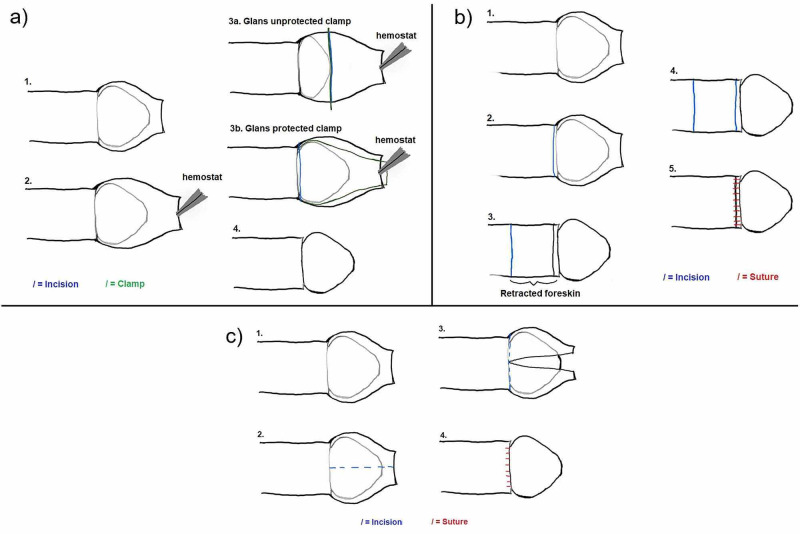
Illustration: Ryan Margolin, in Gologram M, Margolin R, Lomiguen CM, Cureus 2022 · CC BY 4.0
Key takeaways
- Dorsal slit, one of the three surgical methods, is often used when the foreskin is tight.2
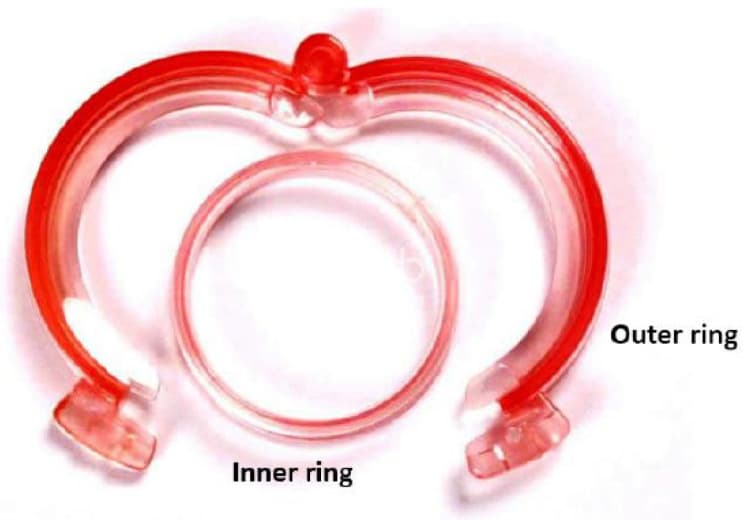
- The ShangRing needs no stitches: two plastic rings clamp the foreskin, and the foreskin is cut away beyond the rings. The device is removed at a visit about a week later.3, 11
- None of the standard methods is clearly better for healing in skilled hands.1, 2
- Preferences about the look differ widely; a US survey found no single preferred look.4
- Dissolving stitches on the outside are how most doctors close the skin.5, 6
At a glance
- Age covered
- Adults; babies have their own methods page
- Methods covered (alphabetical)
- Dorsal slit, forceps-guided, ShangRing, sleeve resection
- What they share
- The foreskin is removed; surgical methods close the skin with stitches
- Main difference
- How the cut is made; the ShangRing needs no stitches
- Who usually decides
- You and your provider discuss the look before the operation
On this page
- How do the adult circumcision methods compare?
- What's the difference between dorsal slit, forceps-guided, ShangRing and sleeve circumcision?
- What is a dorsal slit circumcision?
- What is a forceps-guided circumcision?
- What is the ShangRing?
- What is a sleeve circumcision?
- Is one method better for healing or sensation?
- What is laser circumcision?
- Which method is used, and who decides?
- What do high, low, tight and loose mean in circumcision?
- Is the frenulum removed in adult circumcision?
- How is the wound closed after adult circumcision?
How do the adult circumcision methods compare?
The three surgical methods remove the foreskin with a scalpel or scissors and close the skin with stitches; they differ in how the cut is made.2, 5 The ShangRing is a device: two plastic rings clamp the foreskin, and the foreskin is cut away beyond the rings; no stitches are needed.3, 11 The device is removed at a visit about a week later.11
Adults. Methods in alphabetical order.
| Method | Type | How it works | Stitches? |
|---|---|---|---|
| Dorsal slit | Surgical | The foreskin is first cut open along the top, then removed all the way around; often used for a tight foreskin2 | Yes2 |
| Forceps-guided | Surgical | The foreskin is held in a clamp and cut along it; not used under age 152 | Yes2 |
| ShangRing | Device | Two plastic rings clamp the foreskin, and the foreskin is cut away beyond the rings; the device is removed about a week later; prequalified by the WHO in 2015 for HIV-prevention programs, mainly in Africa3, 11 | No3 |
| Sleeve resection | Surgical | Two lines are marked on the skin, and the band of skin between them is removed2 | Yes2 |
Dorsal slit
Forceps-guided
ShangRing
Sleeve resection
What's the difference between dorsal slit, forceps-guided, ShangRing and sleeve circumcision?
The difference is how the foreskin is cut and held. In a dorsal slit, the foreskin is first cut open along the top and then removed all the way around. In the forceps-guided method, the foreskin is held in a clamp and cut along it. In a sleeve resection, two lines are marked and the band of skin between them is removed.2 All three are stitched. The ShangRing instead clamps the foreskin between two plastic rings, and the foreskin is cut away beyond the rings, with no stitches; the device is removed about a week later.3, 11
What is a dorsal slit circumcision?
A dorsal slit is a surgical method in which the foreskin is first cut open along the top, then removed all the way around.2
- How it works: a cut along the top of the foreskin first, then removal all the way around.2
- Stitches: yes; the edges are stitched together.2
- Things to know: it is often used for a tight foreskin.2 See Phimosis (tight foreskin) in adults.
What is a forceps-guided circumcision?
A forceps-guided circumcision is a surgical method in which the foreskin is held in a clamp and cut along it.2
- How it works: the clamp holds the foreskin, and the cut follows the clamp.2
- Stitches: yes; the edges are stitched together.2
- Things to know: it is not used under age 15.2
What is the ShangRing?
The ShangRing is a male circumcision device, prequalified by the WHO in 2015.3
What is a sleeve circumcision?
A sleeve resection is a surgical method in which two lines are marked on the skin and the band of skin between them is removed.2
- How it works: the provider marks two lines around the shaft and removes the band of skin between them.2
- Stitches: yes; the edges are stitched together.2
- Things to know: a WHO manual says the sleeve method can give a better look, but it takes more skill and a little longer.2
Is one method better for healing or sensation?
In skilled hands, all the standard methods give good results, and none is clearly better for healing.1, 2 A WHO manual says the sleeve method can give a better look, but it takes more skill and a little longer.2 Whether the method changes sensation is UNKNOWN: we found no studies comparing methods.
What is laser circumcision?
Some providers cut with a laser instead of a scalpel; the skin is still closed with stitches. Evidence is limited: one small study found no difference in healing time at 4 weeks.9
Which method is used, and who decides?
Devices such as the ShangRing are used mainly in HIV-prevention programs in Africa.3 Ask your provider which method they use, and why for you.
In practice, most adult circumcisions in the US are surgical, and the method depends mostly on the provider. In practice, the style, meaning how the result looks, is a separate choice you can talk about with your provider before the operation.12
How long does an adult circumcision take?
The operation itself usually takes about 20 to 30 minutes.2, 8 Ask your provider how long yours will take. For pain relief and recovery, see Anesthesia for adult circumcision and Healing after adult circumcision.
What do high, low, tight and loose mean in circumcision?
Preferences about how a circumcision looks differ widely, and a US survey found no single preferred look.4
In practice, providers and men use four informal words for the look: low (the scar line sits closer to the head of the penis), high (the scar line sits further from the head, further down the shaft), tight (more skin is removed, so the skin of the shaft moves less) and loose (more skin is left, so it moves more). In practice, high or low is about where the line goes and tight or loose is about how much skin is left, and they can be combined, as in "low and loose" or "high and tight". In practice, these words come from circumcision specialists and from men discussing circumcision online, not from medical guides, so two providers can use the same word for different results.12
Not every style is possible for every man. It depends on how much skin there is and how the penis looks before the operation.10 So ask the provider to explain, or show you, what they mean.
Which circumcision style do most men choose?
There's no single preferred look: a US survey found that preferences differ widely, and its authors advise surgeons to discuss the look with patients before the operation.4
In practice, most men don't ask for a particular style, and the provider aims for a natural, good-looking result. In practice, some men have a clear preference and bring pictures.12
Does every provider offer style choices?
If the look matters to you, ask any provider whether they take style requests, how often, and to see examples of their results.
In practice, most doctors do a standard medical circumcision. In practice, cosmetic circumcision, with style requests, is offered mainly by circumcision specialists and other providers who focus on it.12
See Who does adult circumcision?.
Is the frenulum removed in adult circumcision?
Usually not. In a standard adult circumcision, the frenulum is usually left in place. If it's short, it's usually corrected during the operation.1, 2, 10 Ask your provider what they will do with yours.
In practice, the frenulum can be kept, partly kept or removed, so it's worth agreeing on this before the operation.12
For a short or torn frenulum, see Short or torn frenulum.
How is the wound closed after adult circumcision?
Most doctors close the skin with dissolving stitches on the outside.5, 6 Stitches placed just under the skin (subcuticular) are a standard way to close a wound when the look matters.10 Surgical glue is also used to close circumcision wounds.7
In practice, providers who focus on cosmetic circumcision often close in layers, with stitches under the surface, and some add surgical glue on top. In practice, the final look takes time, because the scar keeps softening for months.12
Ask how they close it and what the scar line will look like. For care of the wound, see Healing after adult circumcision. If you're unhappy with an earlier result, see Circumcision revision in adults.
Questions to ask your provider
- Which method do you use, and why for me?
- Do you take style requests? How often? Can I see examples of your results?
- What do you mean by high, low, tight and loose? Where will my scar line be?
- What will you do with my frenulum?
- How do you close the wound, and what will the scar look like?
- Can I bring pictures of the look I want?
The bottom line
Adult circumcision is usually a surgical cut with stitches, done by one of three methods; devices are used mainly in HIV-prevention programs in Africa. The look, such as where the scar line sits and how much skin is left, varies, and preferences differ widely. If the look matters to you, ask the provider what each style word means to them, look at their results, and agree on it before the operation.
Sources (12)
- Warees MW, Anand S, Leslie SW, Rodriguez AM. "Circumcision." StatPearls, NCBI Bookshelf (NIH). Updated May 2, 2024. https://www.ncbi.nlm.nih.gov/books/NBK535436/ (accessed Oct 26, 2026)
- World Health Organization and Jhpiego. "Manual for male circumcision under local anaesthesia and HIV prevention services for adolescent boys and men", chapter 9. Apr 19, 2018. https://hivpreventioncoalition.unaids.org/sites/default/files/attachments/MC_manual_2018_chapter_9.pdf (accessed Oct 26, 2026)
- EngenderHealth. "Innovative male circumcision device for HIV prevention receives World Health Organization prequalification." Jun 24, 2015. https://www.engenderhealth.org/article/innovative-male-circumcision-device-for-hiv-prevention-receives-world-health-organization-prequalification (accessed Oct 22, 2026)
- Callegari M, Muncey W, Kim T, Rhodes S, Woo L, Hannick J. "Where to draw the line? Understanding preferences in mucosal collar length after circumcision." Canadian Urological Association Journal 2022;16(9):E473-8 (abstract). https://cuaj.ca/index.php/journal/article/view/7691 (accessed Oct 22, 2026)
- University of Utah Health. "Circumcision as an adult, circumcised vs uncircumcised, phimosis and paraphimosis treatment." Published Apr 6, 2021, modified Sep 15, 2026. https://healthcare.utah.edu/mens-health/treatments/circumcision-frenulotomy (accessed Oct 22, 2026)
- Society of Urologic Nurses and Associates (SUNA). "Circumcision" patient handout. 2022. https://www.suna.org/sites/default/files/download/resources/SUNA_circumcision.pdf (accessed Oct 22, 2026)
- Soni AK, Bais SVS, Kumar S, Sha RR, Baghel B. "A comparative study of suture versus sutureless circumcision." Bioinformation 2025;21(10):3755-3759 (a study in children). https://pmc.ncbi.nlm.nih.gov/articles/PMC12859343 (accessed Oct 22, 2026)
- NHS (England). "Circumcision." Last reviewed Mar 11, 2026. https://www.nhs.uk/tests-and-treatments/circumcision/ (accessed Oct 26, 2026)
- Ronchi P, Manno S, Dell'Atti L. "Technology Meets Tradition: CO2 Laser Circumcision versus Conventional Surgical Technique." Research and Reports in Urology 2020;12:255-260. Jul 16, 2020. https://www.dovepress.com/technology-meets-tradition-co2-laser-circumcision-versus-conventional--peer-reviewed-article-RRU (accessed Oct 26, 2026)
- Dr Mazen Abu Alnasr, MD, General Surgeon (Saudi Board of General Surgery). Reviewer statements for Circumpedia, Oct 23 and 26, 2026.
- Barone MA, Li PS, Lee RK, Ouma D, et al. "Simplifying the ShangRing technique for circumcision in boys and men: use of the no-flip technique with randomization to removal at 7 days versus spontaneous detachment." Asian Journal of Andrology, Jul-Aug 2019 (online Nov 30, 2018). https://pmc.ncbi.nlm.nih.gov/articles/PMC6628734 (accessed Oct 29, 2026)
- Practical experience of a circumcision specialist
See something wrong? Report an error · How we correct pages · How we make our pages