Phimosis in adults: causes, treatment, circumcision
 Medically reviewed by Dr Mazen Abu Alnasr, MD, General Surgeon (Saudi Board of General Surgery)Reviewed Oct 30, 2026
Short answer
Phimosis is a foreskin that is too tight to pull back over the head of the penis.1, 2 In adults, it can cause no trouble at all, or it can make sex, urinating and keeping clean difficult.3 It is often caused by scarring from a skin condition called lichen sclerosus.1, 3 Treatment ranges from gentle care and steroid cream to circumcision.1–3
If your foreskin feels tight, below are the causes, what each treatment involves, and the signs that need help right away.
In babies and young boys, a tight foreskin is normal and usually loosens with time: see Circumcision in babies and children.2, 3
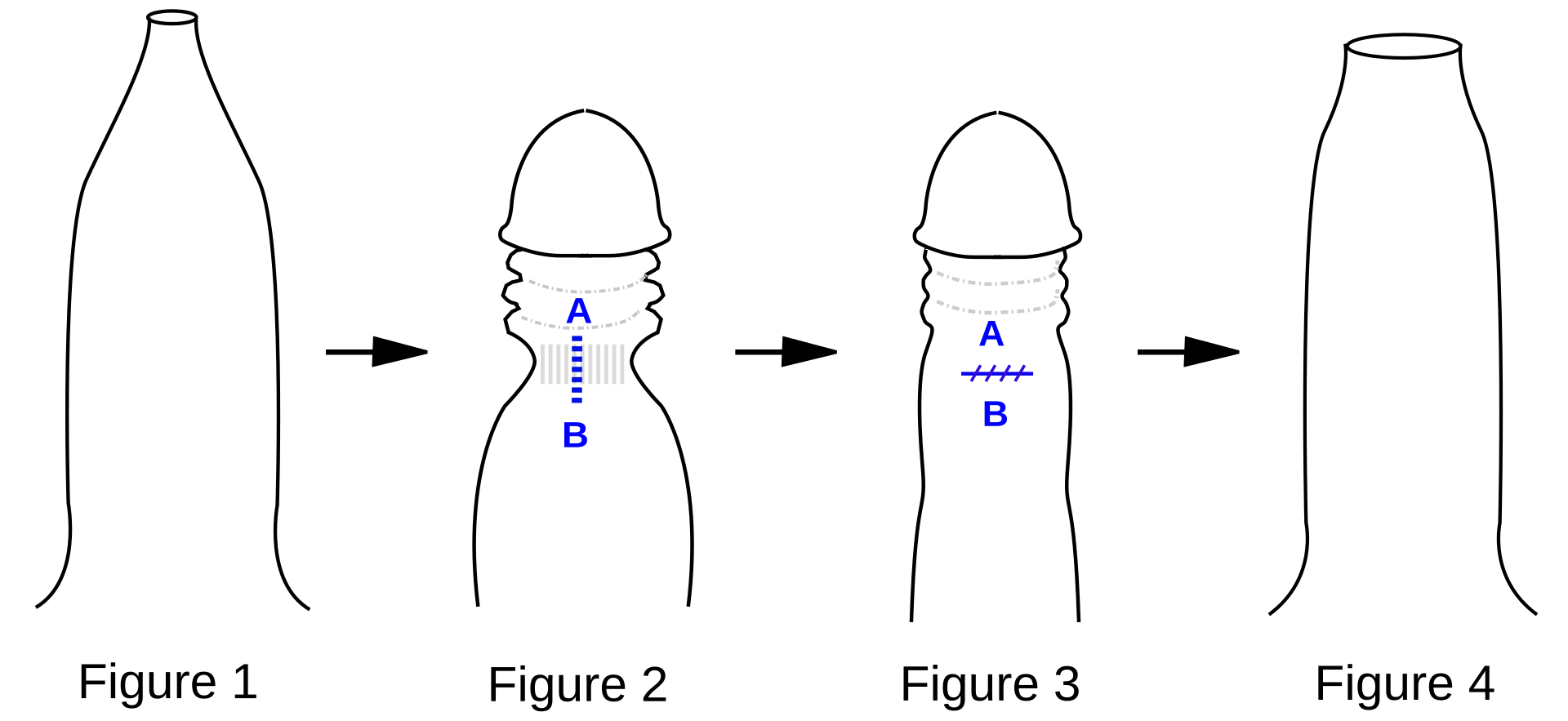
Drawing: Masalai and Ryan258 / Wikimedia Commons
Key takeaways
- Lichen sclerosus, a long-term skin condition that scars the foreskin, often causes phimosis in adults.1, 3
- A tight foreskin that causes no problems may need no treatment, but doctors advise treating lichen sclerosus even when it doesn't hurt or itch.2, 5
- Steroid cream can soften a mildly tight foreskin, but the tightness often comes back when the cream is stopped.1, 3, 8
- Circumcision is the main lasting treatment, especially when the foreskin is scarred.1, 3
- Paraphimosis (a foreskin stuck behind the head) is an emergency: go to the ER right away.2, 3, 8
At a glance
- Also called
- Tight foreskin
- Who this page is for
- Adult men whose foreskin won't pull back
- Main signs
- Foreskin won't pull back; pain, splitting or painful erections
- Causes
- Lichen sclerosus scarring, repeated infection or inflammation, injury
- Tests
- Usually an examination; sometimes blood sugar, urine or biopsy
- Options (least to most invasive)
- Watch and wait, gentle care, steroid cream, treating infection, smaller operations, circumcision
- Emergency sign
- Foreskin stuck behind the head, with swelling (paraphimosis)
On this page
- What are the symptoms of phimosis in adults?
- What causes phimosis in adults?
- What happens if phimosis isn't treated?
- How is phimosis diagnosed in adults?
- How is phimosis treated in adults?
- Can stretching fix phimosis?
- Can you have sex with phimosis?
- Phimosis or paraphimosis: what's the difference?
- What if a tight foreskin doesn't bother you?
- More questions
What are the symptoms of phimosis in adults?
Phimosis in adults means the foreskin won't pull back over the head of the penis.1, 2 Many men with a tight foreskin have no symptoms most of the time; problems often show up during erections or sex.3
See a doctor if you have any of these:
- Pain or swelling: pain, swelling or tenderness of the foreskin.2
- Splitting or discharge: splitting, bleeding, a thick discharge or a bad smell from under the foreskin.2
- Problems urinating: pain when you urinate, a weak stream, or blood in your urine.2
- Infections: frequent urinary infections.2
- Sex: painful erections that make sex difficult.2
The foreskin ballooning when you urinate can happen with a tight foreskin.2, 3, 8
When to call
Call 911 now
- Foreskin stuck behind the head of the penis, and the head swells (paraphimosis): this is an emergency.2, 3 Don't keep trying to force it forward if it hurts.8 Go to the ER right away.2, 8 Don't drive yourself: ask someone to drive you, or call 911 for an ambulance.2
- You can't urinate at all: go to the ER right away.1, 3
Call your provider today
What causes phimosis in adults?
In adults, phimosis is often caused by scarring from lichen sclerosus; repeated infection or inflammation, and injury, can also cause it.1, 3 Causes in adults include:
- Lichen sclerosus (also called balanitis xerotica obliterans, or BXO): a long-term skin condition that scars the foreskin and leaves a tight, whitish ring near its tip. It often causes a tight foreskin in adults.1, 3 Lichen sclerosus isn't contagious.5
- Repeated infection or inflammation of the head of the penis and the foreskin (balanitis): long-lasting inflammation can tighten the foreskin over time.3, 4
- Injury to the foreskin, which can heal with scarring.3
Diabetes can be linked to foreskin infections and tightness.3, 4
What happens if phimosis isn't treated?
A scarred foreskin that is left untreated can lead to more irritation and infection, bleeding, and narrowing of the opening at the tip of the penis that urine comes out of.1, 3 Rarely, a man can't urinate at all; that needs help right away.1, 3
A tight foreskin that is pulled back can also get stuck behind the head of the penis (paraphimosis), which is an emergency: see Phimosis or paraphimosis: what's the difference?2
How is phimosis diagnosed in adults?
A doctor can usually diagnose phimosis by looking at the foreskin and asking about your symptoms; tests and scans are usually not needed for that.1
Some men need one of these checks:
- Blood sugar or urine test: repeated foreskin infections can be a sign of diabetes that hasn't been found yet, so a doctor may test your blood sugar or urine.3, 4
- Biopsy: if the doctor thinks it could be lichen sclerosus, a small sample of skin (biopsy) may be needed.4, 5
- Lab check after circumcision: the removed foreskin is usually sent to a lab to confirm the cause.1
How is phimosis treated in adults?
Treatment for phimosis in adults depends on the cause and how much scarring there is.1 A tight foreskin that causes no problems may need no treatment, and steroid cream can soften mild tightness.1–3 Circumcision is the usual treatment for adults with a tight foreskin that causes problems, and the main treatment once lichen sclerosus has scarred it.1, 3
Options are listed from least to most invasive.
Table: treatments for phimosis in adults (United States)
| Option | When it's used | Things to know |
|---|---|---|
| Watch and wait | A tight foreskin that causes no problems2 | Doctors advise treating lichen sclerosus even when it doesn't hurt or itch5 |
| Gentle care | Everyday cleaning and comfort2, 3 | Warm water, or warm water and an unscented soap; a condom or lubricant may make sex more comfortable2, 3, 6 |
| Steroid cream or ointment | Mild scarring1, 3 | Usually 4 to 8 weeks, longer for lichen sclerosus; tightness often comes back when stopped1, 3, 8 |
| Treating infection or inflammation | Infection or inflammation of the head and foreskin (balanitis)2, 4 | Treated according to its cause; some balanitis is fungal and needs an antifungal cream2, 4 |
| Smaller operations | Preputioplasty is rarely suitable for adults; frenuloplasty when the frenulum is short2, 3 | Removing only part of the foreskin is not recommended3 |
| Circumcision | The usual treatment when the foreskin causes problems; the main one once scarred1, 3 | The removed foreskin is usually sent to a lab to confirm the cause1 |
Watch and wait
Gentle care
Steroid cream or ointment
Treating infection or inflammation
Smaller operations
Circumcision
Official guidance usually starts with waiting and creams. In practice, many circumcision specialists recommend going straight to circumcision for men who are open to it, because creams often don't help and men can be left with ongoing problems. Many doctors prefer to try cream first. Once the foreskin is removed, the foreskin tightness can't come back, although lichen sclerosus can still affect the head of the penis.9
Watch and wait
- What it involves: No treatment, as long as the foreskin causes no problems.2
- When it may be used: When a tight foreskin causes no problems and it isn't lichen sclerosus.2, 5
- Things to know: Doctors advise treating lichen sclerosus even when it doesn't hurt or itch. See What if a tight foreskin doesn't bother you?5
Gentle care
- What it involves: Washing with warm water, or warm water and an unscented soap.2
- When it may be used: Every day, alone or alongside other treatment.2
- Things to know: A condom or a lubricant can make sex more comfortable.3, 6
Steroid cream or ointment
- What it involves: A course usually lasts 4 to 8 weeks, or longer if lichen sclerosus is the cause, as your doctor prescribes.1, 8
- When it may be used: A course of steroid cream can soften the foreskin when scarring is mild, but the tightness often comes back when the cream is stopped.1, 3, 8 Once lichen sclerosus has clearly scarred the foreskin, creams are less likely to help, although a doctor may still try a strong steroid cream first.1, 6
- Things to know: Stretching may be added: see Can stretching fix phimosis?
In practice, cream isn't a lasting fix for many adults.9
Treating infection or inflammation
- What it involves: Treatment according to the cause; for example, some balanitis is fungal and needs an antifungal cream.2, 4
- When it may be used: When the head of the penis and the foreskin are infected or inflamed (balanitis).2, 4
- Things to know: Repeated infections can be a sign of diabetes that hasn't been found yet, so a doctor may test your blood sugar or urine.3, 4
Smaller operations
- What it involves: An operation that keeps the foreskin: preputioplasty, or frenuloplasty when the problem is a short frenulum.2, 3
- When it may be used: Preputioplasty is mainly used in children and is rarely suitable for adults.2, 3 If the problem is a short frenulum, frenuloplasty may be enough.3
- Things to know: Removing only part of the foreskin is not recommended.3
Circumcision
- What it involves: Removing the foreskin. See Adult circumcision methods and styles and Anesthesia for adult circumcision.1, 3
- When it may be used: The usual treatment for adults with a tight foreskin that causes problems, and the main treatment once lichen sclerosus has scarred it.1, 3
- Things to know: The removed foreskin is usually sent to a lab to confirm the cause.1 For recovery, see Healing after adult circumcision.
Can stretching fix phimosis?
If the foreskin is tight but not scarred, gentle stretching, often with a steroid cream, can help.7, 8 Pull it back only as far as is comfortable, never to the point of pain.8
Don't stretch a scarred foreskin: it can tear and scar more.3, 8 British urologists (BAUS) said in 2024 that there is no scientific evidence that stretching a diseased foreskin produces a cure.3
Can you have sex with phimosis?
Many men with a mildly tight foreskin can still have sex.8 Problems often show up during erections or sex.3 A condom or a lubricant can make it more comfortable.3, 6
A tight or scarred foreskin can tear and bleed during sex.6 Don't force it back: if it gets stuck behind the head, that's an emergency.2 Stop if it hurts.8
Phimosis or paraphimosis: what's the difference?
Phimosis: the foreskin is too tight to pull back over the head of the penis. It is often not urgent. Paraphimosis: a foreskin that was pulled back is stuck behind the head and won't go back; the head swells and hurts. This is an emergency.2, 3, 8
| Phimosis | Paraphimosis |
|---|---|
| The foreskin is too tight to pull back over the head of the penis. | A foreskin that was pulled back is stuck behind the head and won't go back; the head swells and hurts. |
| It is often not urgent. | This is an emergency. |
What if a tight foreskin doesn't bother you?
If your foreskin is tight but causes no problems, you may not need any treatment.2 Check first whether it could be lichen sclerosus: doctors advise treating it even when it doesn't hurt or itch.5 Regular check-ups are advised, because scarred skin carries a very small risk of skin cancer.5
In practice, some men choose circumcision early, to prevent future problems.9
Choosing circumcision early is a personal choice to make with a provider.
More questions
Can phimosis go away on its own in adults?
Whether phimosis in adults goes away without treatment is not known: research is limited. In babies and young boys, a tight foreskin is normal and usually loosens with time.2, 3 In adults, steroid cream can soften mild tightness, but the tightness often comes back when the cream is stopped.1, 3, 8
Is phimosis common in adults?
How common it is in adult men is UNKNOWN: we found no good figures.8 The figures we found are for boys only.1
What kind of doctor treats phimosis?
Start with your own doctor (primary care doctor), who can look at the foreskin and check for the causes.1, 2 For lichen sclerosus, a dermatologist (a skin specialist) may advise you how and when to use strong steroid ointments.6 Adult circumcision is typically done by a general surgeon or a urologist.7 See Who does adult circumcision?
Do and don't
Do
- Wash with warm water, or warm water and an unscented soap.2
- Use a condom or a lubricant during sex if it makes sex more comfortable.3, 6
- Ask your doctor whether it could be lichen sclerosus, even if it doesn't hurt or itch.5
- Keep up regular check-ups if you have lichen sclerosus.5
- Ask about a blood sugar test if you keep getting foreskin infections.3, 4
Questions to ask your provider
- Is my foreskin scarred? Could it be lichen sclerosus, and do I need a biopsy?
- Should my blood sugar be checked?
- Is cream likely to work for me, and how long would I use it?
- Is gentle stretching right for me?
- What happens if I wait?
- Would a smaller operation be enough, or is circumcision the better fix in my case?
The bottom line
Phimosis in adults is often caused by scarring from lichen sclerosus. Creams and smaller operations help some men, but problems often come back, and circumcision is the lasting fix when other treatments don't work. If a tight foreskin causes no problems and isn't lichen sclerosus, you may not need treatment. A foreskin stuck behind the head is an emergency: go to the ER right away.
Sources (9)
- McPhee AS, Stormont G, McKay AC. "Phimosis." StatPearls, NCBI Bookshelf (NIH). Updated Aug 8, 2023. https://www.ncbi.nlm.nih.gov/books/NBK525972/ (accessed Oct 26, 2026)
- NHS (England). "Tight foreskin (phimosis)." Reviewed Mar 6, 2026. https://www.nhs.uk/conditions/phimosis/ (accessed Oct 29, 2026)
- British Association of Urological Surgeons (BAUS). "Tight foreskin (phimosis)." March 2024 (review due August 2026). https://www.baus.org.uk/patients/conditions/13/tight_foreskin_phimosis/ (accessed Oct 26, 2026)
- Wray AA, Velasquez J, Leslie SW. "Balanitis." StatPearls, NCBI Bookshelf (NIH). Updated Aug 31, 2024. https://www.ncbi.nlm.nih.gov/books/NBK537143/ (accessed Oct 22, 2026)
- National Institute of Arthritis and Musculoskeletal and Skin Diseases (NIAMS, NIH). "Lichen sclerosus" (undated). https://www.niams.nih.gov/health-topics/lichen-sclerosus (accessed Oct 22, 2026)
- British Association of Dermatologists. "Lichen sclerosus in males" (patient information leaflet). September 2022. https://www.skinhealthinfo.org.uk/wp-content/uploads/2018/11/LICHEN-SCLEROSUS-MALE-SEP-2022.pdf (accessed Oct 26, 2026)
- Warees MW, Anand S, Leslie SW, Rodriguez AM. "Circumcision." StatPearls, NCBI Bookshelf (NIH). Updated May 2, 2024. https://www.ncbi.nlm.nih.gov/books/NBK535436/ (accessed Oct 26, 2026)
- Dr Mazen Abu Alnasr, MD, General Surgeon (Saudi Board of General Surgery). Reviewer statements for Circumpedia, Oct 23, 26 and 29, 2026.
- Practical experience of a circumcision specialist
See something wrong? Report an error · How we correct pages · How we make our pages