Adult circumcision benefits and risks: what studies show
 Medically reviewed by Dr Mazen Abu Alnasr, MD, General Surgeon (Saudi Board of General Surgery)Reviewed Nov 8, 2026
Short answer
For adult men, circumcision has possible health benefits and possible risks. In trials in Africa, it lowered men's risk of getting HIV and some other sexually transmitted infections from vaginal sex, but did not remove it.1 It is also the main treatment once lichen sclerosus has scarred the foreskin.7 Like any operation, it carries risks: the problems reported most often are pain, bleeding, infection and being unhappy with how it looks.1, 8, 9 How these weigh up depends on your reasons and your health.
All adult pages: Circumcision in adults. Compare: Circumcised vs uncircumcised penis: looks, care, health.
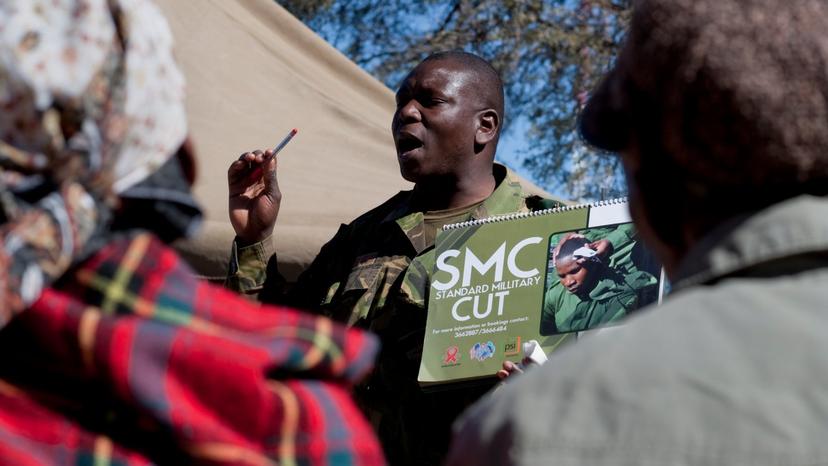
Photo: US Army Africa / Wikimedia Commons · CC BY 2.0
Key takeaways
- The HIV benefit was found for sex with women; it hasn't been shown to lower the risk for the receptive partner in anal sex.1
- Circumcision lowers infection risk but doesn't remove it: condoms, fewer partners and PrEP (HIV prevention medicine) still matter.1
- Most problems after the operation are minor, such as bleeding.2
- On average, men circumcised as adults report little or no change in sexual satisfaction or function, but men who enjoy the feel of the foreskin during sex lose that sensation.1
- For an adult, it's his own decision, made with his provider.1
On this page
What are the possible health benefits?
- HIV: in trials in Africa, circumcision lowered men's risk of getting HIV from vaginal sex, but did not remove it. It hasn't been shown to lower the risk for the receptive partner in anal sex.1
- Other sexually transmitted infections: circumcised men were less likely to get genital herpes (HSV-2) and high-risk types of human papillomavirus (HPV), and less likely to have genital ulcers and trichomoniasis.1
- Urinary infections: circumcised males get fewer urinary tract infections, most clearly in infancy; the CDC also reports a lower risk in men over 16.1
- Penile cancer: cancer of the penis is very rare.10 Invasive cancer of the penis (cancer that has grown into deeper tissue) is less common in men who were circumcised as children or teenagers; studies haven't shown the same for circumcision in adulthood.11
- Foreskin problems: circumcision is the main treatment once lichen sclerosus has scarred the foreskin.7 It's also usually needed for a tight foreskin when creams haven't worked.3
Condoms, fewer partners and PrEP still matter, whether you're circumcised or not.1
Does circumcision protect a man's partner?
For female partners, circumcision of the man hasn't been shown to lower the risk of HIV passing to them.1 Female partners of circumcised men had lower rates of trichomoniasis, bacterial vaginosis, genital ulcers and high-risk HPV.1
Men who have sex with men
The evidence isn't clear enough for firm conclusions for men who have sex with men.1 It hasn't been shown to lower the risk for the receptive partner in anal sex.1
What are the risks?
Like any operation, adult circumcision carries risks.2
- Most often: pain, bleeding, infection and being unhappy with how it looks. Others include swelling and a collection of blood under the skin. Problems with the anesthetic are rare.1, 8, 9
- A second operation: sometimes another operation is needed, for example to stop bleeding or to remove more skin.2
- The urine tube: rarely, the urethra narrows or is damaged. This can make it hard to urinate and may need surgery.2
- Too much skin removed: if too much shaft skin is removed, the penis can look shorter (see Circumcision revision in adults).6
- How it looks: give it time; the look keeps improving for a few months after the wound has healed.17
Sensation, sex and length
A lasting change in the feeling of the head of the penis is common; UK urologists describe it as altered or reduced. Most studies, however, don't show less sexual pleasure or satisfaction.1, 3, 4 On average, men circumcised as adults report little or no change in sexual satisfaction or function. Men who enjoy the feel of the foreskin during sex lose that sensation.1 Erections continue as normal; at first there may be some tightness around the scar.3 Circumcision doesn't shorten the penis.4
What do men worry about most?
In practice, men most often worry about pain and about how it will look. See pain relief for adult circumcision and recovery week by week.17
Benefits and risks side by side
Adult men: possible benefits and risks side by side
| Area | Possible benefit | Possible risk |
|---|---|---|
| Infections | Lower risk of HIV and some other infections from vaginal sex, fewer urinary infections, most clearly in infancy | Infection of the wound after surgery1 |
| The operation | Treats some foreskin problems such as scarring from lichen sclerosus7 | Pain, bleeding, swelling; sometimes a second operation; rarely, damage to the urine tube1, 2 |
| Sex and sensation | Little or no change in satisfaction, on average1 | A lasting change in the feeling of the head; the foreskin's own sensation is lost1, 3 |
| Appearance | Some men prefer the look9 | Being unhappy with how it looks1 |
Infections
- Possible benefit
- Lower risk of HIV and some other infections from vaginal sex, fewer urinary infections, most clearly in infancy
- Possible risk
- Infection of the wound after surgery1
The operation
Sex and sensation
Appearance
What medical bodies say
They differ by setting.1, 2, 5
- United States: the CDC's 2018 guidance sets out the benefits and risks for men to weigh with their provider; it says an adult can make the decision for himself.1
- World Health Organization: since 2007, the WHO and UNAIDS have recommended voluntary medical circumcision to prevent HIV caught through sex with women, in places where that kind of HIV is common.5
- England's NHS: it offers circumcision only for medical reasons, such as repeated infections or a tight foreskin.2
When to call
Call 911 now
- After circumcision: heavy bleeding that doesn't stop with firm pressure, or you feel faint or seriously unwell. Go to the ER right away.9, 13
- If you're not circumcised: your foreskin is stuck behind the head of the penis, the head swells, and the foreskin won't come forward again (paraphimosis). This is an emergency: go to the ER right away.3, 7, 8, 12
- You can't urinate at all, or your lower belly feels painfully full and you can't empty your bladder: go to the ER.16
Call your provider today
- After circumcision: if the head of the penis is numb, very pale or looks blue, the dressing may be too tight. Take it off at once and put it back on more loosely, then call your provider. If the color doesn't come back within a few minutes, or you can't reach your provider, go to an emergency room.14
- After circumcision: bleeding that doesn't stop after 5 to 15 minutes of firm pressure.13
- After circumcision: a fever or chills (providers give 100.4°F (38°C) or 101°F as the line).9, 14, 15
- After circumcision: spreading redness, warmth or swelling, pus, a bad smell, or the wound opening.9, 14, 15
- After circumcision: pain your painkillers don't control.9, 15
- You can't urinate within about 8 hours of going home.16
Questions to ask your provider
- What would circumcision do for my reason, and what else could I try first?
- What happens if I do nothing?
- Which problems do you see most often after the operation, and how are they handled?
- How might it change sensation for me?
- If I want protection from HIV or other infections, what else should I use as well?
The bottom line
Adult circumcision can lower some infection risks and treat some foreskin problems, and like any operation it can cause problems of its own. Most problems are minor. It can't be undone, so weigh your reason, your health and what matters to you in sex with your provider.
Sources (17)
- US Centers for Disease Control and Prevention (CDC). "Information for Providers to Share with Male Patients and Parents Regarding Male Circumcision and the Prevention of HIV Infection, Sexually Transmitted Infections, and other Health Outcomes." Aug 22, 2018. https://stacks.cdc.gov/view/cdc/58456 (accessed Nov 8, 2026)
- NHS (England). "Circumcision in men." Reviewed Mar 11, 2026. https://www.nhs.uk/conditions/circumcision-in-men/ (accessed Oct 26, 2026)
- British Association of Urological Surgeons (BAUS). "Complete removal of the foreskin (circumcision)," patient leaflet A24/077. June 2024 (review due Sep 2026). https://www.baus.org.uk/_userfiles/pages/files/Patients/Leaflets/Circumcision.pdf (accessed Oct 26, 2026)
- University of Utah Health. "Circumcision as an adult, circumcised vs uncircumcised, phimosis and paraphimosis treatment." Published Apr 6, 2021, updated Sep 15, 2026. https://healthcare.utah.edu/mens-health/treatments/circumcision-frenulotomy (accessed Oct 26, 2026)
- World Health Organization (WHO). Policy brief on voluntary medical male circumcision, 2020. https://www.who.int/publications/i/item/978-92-4-000966-0 (accessed Nov 5, 2026)
- Warees MW, Anand S, Leslie SW, Rodriguez AM. "Circumcision." StatPearls (NCBI Bookshelf, US National Library of Medicine). Updated May 2, 2024. https://www.ncbi.nlm.nih.gov/books/NBK535436/ (accessed Oct 26, 2026)
- British Association of Urological Surgeons (BAUS). "Tight foreskin (phimosis)." March 2024 (review due Aug 2026). https://www.baus.org.uk/patients/conditions/13/tight_foreskin_phimosis/ (accessed Oct 26, 2026)
- Holman JR, Stuessi KA. "Adult Circumcision." American Family Physician (American Academy of Family Physicians), Mar 15, 1999;59(6):1514-1518. https://www.aafp.org/pubs/afp/issues/1999/0315/p1514.html (accessed Oct 26, 2026)
- Society of Urologic Nurses and Associates (SUNA). "Circumcision" patient handout. 2022. https://www.suna.org/sites/default/files/download/resources/SUNA_circumcision.pdf (accessed Oct 22, 2026)
- NHS (England). "Penile cancer." https://www.nhs.uk/conditions/penile-cancer/
- Larke N, et al. "Male circumcision and penile cancer: a systematic review and meta-analysis." 2011. https://pmc.ncbi.nlm.nih.gov/articles/PMC3139859 (accessed Nov 8, 2026)
- NHS (England). "Tight foreskin (phimosis)." Reviewed Mar 6, 2026. https://www.nhs.uk/conditions/phimosis/ (accessed Oct 26, 2026)
- Naval Medical Center Portsmouth (US Navy), Urology Clinic. "Adult Circumcision Information Sheet." Updated Nov 4, 2011. https://portsmouth.tricare.mil/Portals/130/AdultCircumcision.pdf (accessed Oct 26, 2026)
- UW Medicine. "After Your Surgery: Adult circumcision." 2011, clinician review Aug 2013. https://honline.s.uw.edu/sites/default/files/record_pdfs/After-Your-Surgery-Adult-circumcision.pdf (accessed Oct 26, 2026)
- Salem Health Urology. "Adult circumcision postoperative instructions." Undated. https://www.salemhealth.org/docs/default-source/urology/post-op-instruction-sheets/adultcircumcision_postop_120924.pdf (accessed Oct 22, 2026)
- AORN / Outpatient Surgery Magazine. "What Do You Know About Post-Op Urinary Retention?" Nov 2011. https://aorn.org/outpatient-surgery/article/2011-November-what-do-you-know-about-post-op-urinary-retention (accessed Oct 22, 2026)
- Practical experience of a circumcision specialist
See something wrong? Report an error · How we correct pages · How we make our pages