Baby circumcision: timing, methods, healing, care
 Medically reviewed by Dr Aslı Özbayoğlu, MD, Specialist in Pediatric SurgeryReviewed Nov 1, 2026
Short answer
Circumcision of a baby or boy removes the foreskin, the skin that covers the head of the penis.1, 2 In the US, most circumcisions are done in a baby's first 10 days of life, and every baby should get pain relief.2, 3 Doctors usually use general anesthesia for older boys.4
If you're deciding about circumcision for your son, or caring for him afterward, start with the questions below, in the order you'll meet them.
For men 18 and over, see Circumcision in adults.

Photo: Marius Muresan / Unsplash
Key takeaways
- Newborn circumcision is usually delayed until at least 12 hours after birth, and some babies should wait until a doctor says it's safe.4, 5
- The Gomco clamp, the Mogen clamp and the Plastibell ring are the three most common methods for newborns.3
- A title or certificate alone doesn't show how much circumcision experience a provider has, so ask every provider the same questions.
- Penile adhesions, where skin sticks to the head of the penis after circumcision, are common and often separate by themselves.6, 7
At a glance
- What it is
- Removing the foreskin, the skin covering the head of the penis
- Main reasons
- Religious, cultural and personal, weighed with medical benefits and risks
- Who performs it
- Doctors, mohels, nurse practitioners and nurse-midwives; depends on age. Some of these providers are circumcision specialists.
- Main methods
- Gomco clamp, Mogen clamp and Plastibell ring (the three most common)
- Healing
- Most heal in 7 to 10 days; fully by about 4 weeks
- Start here
- Newborn circumcision, then methods, who does it, and problems afterward
Start here


Problems

More in this section

On this page
- Should I circumcise my son?
- When are babies circumcised?
- Which babies should wait for circumcision?
- Who circumcises babies and boys?
- How do they circumcise a baby?
- Does circumcision hurt a baby?
- How long does a baby's circumcision take to heal?
- What problems can happen after a baby's circumcision?
- More questions parents ask
Should I circumcise my son?
Whether to circumcise a baby is the parents' decision.1 Parents weigh religious, cultural and personal reasons with the medical benefits and risks.1 Some babies should wait until a doctor says it's safe; see "Which babies should wait for circumcision?" below.5 The pages below give the facts, with sources, and the questions to ask a provider.
Read more: Newborn circumcision
When are babies circumcised?
In the hospital, most newborn circumcisions are done in the first 10 days, often within 48 hours.2 Circumcision is usually delayed until at least 12 hours after birth, depending on the baby's condition and hospital policy.4 For Jewish families, a mohel does the bris (brit milah) on the eighth day, unless the baby's health means waiting.8 Some doctors do it in the office in the first weeks; whether a baby can have it in the office depends on his health and on the provider's own rules.2, 9 Boys can also be circumcised later; see "Can toddlers and older boys be circumcised?" below.
Read more: Newborn circumcision
Which babies should wait for circumcision?
Circumcision should wait until a doctor says it's safe if, for example, a baby:
- is premature or unwell
- has jaundice still being checked or treated
- has a known bleeding disorder, or a strong family history of a bleeding disorder
- has a difference in how the penis formed, such as hypospadias.2, 4, 5
With hypospadias, the opening where urine comes out is not in its usual place at the tip of the penis.10 Before a newborn is circumcised, conditions such as hypospadias, a hydrocele or a hernia need a check by a pediatric surgeon or pediatric urologist.
Read more: Newborn circumcision · Who does newborn and child circumcision?
Who circumcises babies and boys?
Who circumcises your son depends mostly on his age. Older boys can be circumcised by mohels who do older boys, pediatric surgeons and pediatric urologists, and urologists. A title or certificate alone doesn't show how much experience someone has, so ask every provider the same questions.
Read more: Who does newborn and child circumcision?
How do they circumcise a baby?
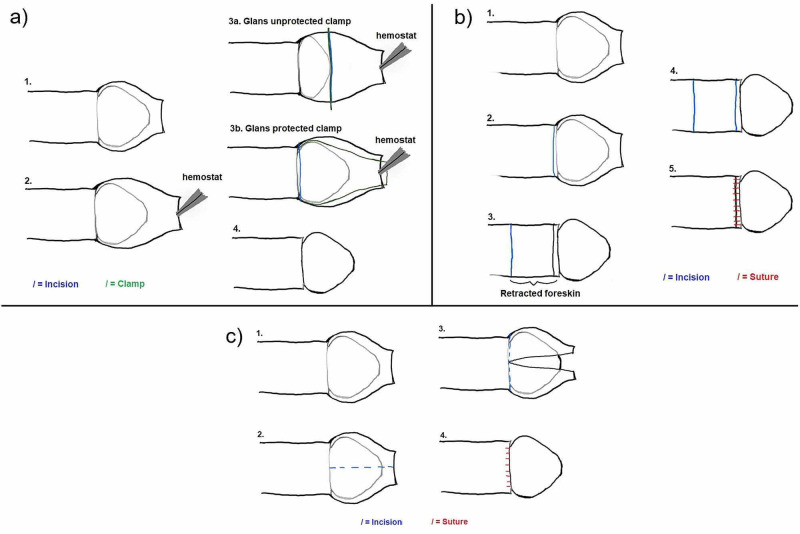
The area is cleaned, every baby should get pain relief, and then the foreskin is removed.3, 4 Hospital doctors mostly use one of three devices: the Gomco clamp, the Mogen clamp or the Plastibell ring.4 A Gomco clamp takes up to 10 minutes, a Mogen clamp less than 5 minutes, and a Plastibell up to 10 minutes.3 With the Plastibell, a plastic ring stays on and usually falls off by itself in 5 to 10 days.2
In practice, Orthodox mohels use the traditional shield (magen) and don't use clamps, for religious reasons. In practice, some mohels use a Mogen clamp, especially outside Orthodox communities or for families who aren't Jewish. In practice, with the shield, the cut takes only seconds.13
Read more: Newborn circumcision methods
Does circumcision hurt a baby?
Newborn circumcision is painful, so every baby should get pain relief, whatever the method.3 A numbing injection at the base of the penis (nerve block) is recommended; numbing cream and sugar water can be added, but they shouldn't replace the injection.3, 4 Some providers suggest acetaminophen (Tylenol) afterward; others don't, so only give a medicine your provider advises.2, 11 Doctors usually use general anesthesia for older boys.4
Read more: Newborn circumcision
How long does a baby's circumcision take to heal?
Most babies heal in 7 to 10 days, and full healing takes up to about 4 weeks.2, 4 At first the penis is red and a little swollen, and the swelling can also reach the shaft.2 After a day or two, a thin yellow film or crust is normal healing, not pus.2, 7 At home, care usually means gentle cleaning with warm water and, if your provider recommends them, petroleum jelly and keeping the head of the penis uncovered.2, 9 Follow your provider's instructions for the method used, because Plastibell care differs.2, 4 A Plastibell ring is left to fall off by itself.2, 11
Read more: Newborn circumcision
What problems can happen after a baby's circumcision?
After a newborn circumcision, the skin of the penis can stick to the head (an adhesion) or form a band of skin (a skin bridge).6, 7 More foreskin than parents expected can also be left.6, 7 Many of these problems, especially adhesions, settle by themselves or with a cream; skin that looks like too much often becomes less noticeable as he grows; only some need a small procedure or a second operation (a revision).6, 7 Adhesions are common, usually harmless and often separate by themselves; skin bridges usually don't separate by themselves and usually need a small procedure.6, 7 Your child's doctor can usually tell you which is which.
For signs to watch for in the first days after a newborn circumcision, such as bleeding or pus, see the When to call box below.
Read more: Penile adhesions, skin bridges and revision in boys
More questions parents ask
Where is a baby circumcised?
A newborn circumcision is often done before the baby leaves the hospital.1, 2 Some doctors do it in their office in the first weeks.2, 9 A bris is held at home or in a synagogue.8 Older boys often have it as a same-day operation in a hospital operating room.
What is a bris, and how is it different from a hospital circumcision?
A bris (brit milah) is the Jewish circumcision ceremony.8 A mohel does it on the eighth day, at home or in a synagogue, and postpones it if the baby isn't healthy enough.8 A hospital circumcision is usually done in the first days of life.2 Hospital doctors mostly use a Gomco clamp, a Mogen clamp or a Plastibell ring.4
In practice, pain relief differs between mohels, and not all use the same method. In practice, many mohels doing a traditional circumcision with the shield don't give an injection and use another kind of numbing instead. Ask the mohel what he uses. In practice, many mohels also circumcise boys from families who aren't Jewish.13
Can toddlers and older boys be circumcised?
Yes. Boys can be circumcised at any age.4 After the newborn period, it's usually done in an operating room with general anesthesia.2 Some doctors recommend avoiding a planned circumcision between about ages 3 and 6 (the "phallic stage" of a child's development), because of concerns about his development and feelings. But the evidence is limited and mixed, and current pediatric urology guidelines don't set a specific age at which circumcision shouldn't be done.
In practice, some parents prefer to avoid general anesthesia at these ages. In practice, a mohel who circumcises boys of all ages does it between about 3 and 6 with a local anesthetic only.13
Read more: Who does newborn and child circumcision?
When to call
Call 911 now
Call your provider today
- For a baby under 12 weeks, a fever of 100.4°F (38°C) or higher: call your provider right away or go to the emergency department for immediate evaluation2
- The head of the penis looks dark blue or black: go to the emergency department right away11
- Severe pain: call your provider right away or go to the emergency department for immediate evaluation2
- Right away if there's unusual sleepiness, or poor feeding with signs of illness
- Right away if bleeding is more than a few drops, or there's a bloodstain on the diaper bigger than a quarter11, 12
- Right away if there's no wet diaper within 6 to 8 hours, or he can't urinate or passes only a few drops of urine2, 12
- Right away if redness or swelling gets worse, including severe swelling of the penis, or you see pus2, 11
These are the main signs, not the full list. All the signs for newborns: When to call, on Newborn circumcision. With a Plastibell ring: When to call, on Newborn circumcision methods. For later problems, such as a urine stream that sprays or dribbles: When to call, on Penile adhesions, skin bridges and revision in boys.
Questions to ask your provider
- How many circumcisions have you done for babies (or boys) of my son's age?
- Which method do you use, and why?
- What pain relief do you use, during and after?
- Should a pediatric surgeon or pediatric urologist check my baby first?
- What should we do at home, and for how long?
- What happens if there's bleeding or another problem afterward? Can we reach you directly, including at night?
The bottom line
The main practical questions about circumcision for a baby or boy are when it's done, who does it, which method is used and how to care for him afterward. Each has its own page. Asking every provider the same questions lets you compare their answers. Problems afterward, such as adhesions, often settle by themselves, but the signs in the When to call box need a call.
Latest news
This section's medical reviewers

Sources (13)
- MedlinePlus (U.S. National Library of Medicine). "Circumcision" (health topic). Updated Jul 30, 2024. https://medlineplus.gov/circumcision.html (accessed Oct 22, 2026)
- Nemours KidsHealth. "Circumcision" (for parents). Reviewed May 2026. https://kidshealth.org/en/parents/circumcision.html (accessed Oct 26, 2026)
- Omole F, Smith W, Carter-Wicker K. "Newborn Circumcision Techniques." American Family Physician 2020;101(11):680-685. American Academy of Family Physicians. Jun 1, 2020. https://www.aafp.org/pubs/afp/issues/2020/0601/p680.html (accessed Oct 26, 2026)
- Warees MW, Anand S, Leslie SW, Rodriguez AM. "Circumcision." StatPearls, NCBI Bookshelf (NBK535436). Updated May 2, 2024. https://www.ncbi.nlm.nih.gov/books/NBK535436/ (accessed Oct 26, 2026)
- Stanford Medicine Newborn Nursery. "Contraindications to Routine Circumcision." Dec 9, 2025. https://med.stanford.edu/newborns/professional-education/circumcision/contraindications.html (accessed Oct 26, 2026)
- Children's Hospital of Philadelphia (CHOP). "Penile Adhesions." Reviewed Jun 16, 2026. https://www.chop.edu/conditions-diseases/penile-adhesions (accessed Oct 26, 2026)
- Stanford Medicine Newborn Nursery. "Complications of Circumcision." Jun 7, 2016. https://med.stanford.edu/newborns/professional-education/circumcision/complications.html (accessed Oct 26, 2026)
- My Jewish Learning. "Planning a Brit Milah (Bris)." G. Robinson. Modified Oct 12, 2022. https://www.myjewishlearning.com/article/planning-a-brit-milah-bris/ (accessed Oct 22, 2026)
- Children's Hospital of Philadelphia (CHOP). "Circumcision." Reviewed Dec 2024. https://www.chop.edu/treatments/circumcision (accessed Oct 26, 2026)
- Children's Hospital of Philadelphia (CHOP). "Hypospadias." Reviewed Dec 16, 2025. https://www.chop.edu/conditions-diseases/hypospadias (accessed Oct 26, 2026)
- Seattle Children's. "Circumcision Problems." Reviewed May 6, 2025. https://www.seattlechildrens.org/conditions/a-z/circumcision-problems/ (accessed Oct 26, 2026)
- Nemours KidsHealth. "After Circumcision: How to Care for Your Baby." Created May 8, 2018 (©2026). https://khpi.kidshealth.org/en/parent/1553.html (accessed Oct 26, 2026)
- Practical experience of a circumcision specialist
See something wrong? Report an error · How we correct pages · How we make our pages