Similar STD rates in circumcised and uncircumcised men
The short version
In national surveys from Malawi, Rwanda, Zambia and Zimbabwe, circumcised and uncircumcised men self-reported sexually transmitted infections (STIs) at about the same rate, with no statistically significant difference. Men also reported STIs more often in surveys taken after voluntary circumcision programs grew than in surveys taken before. Because the figures are self-reported and come from two sets of surveys years apart, the study can't show whether the programs caused the rise.
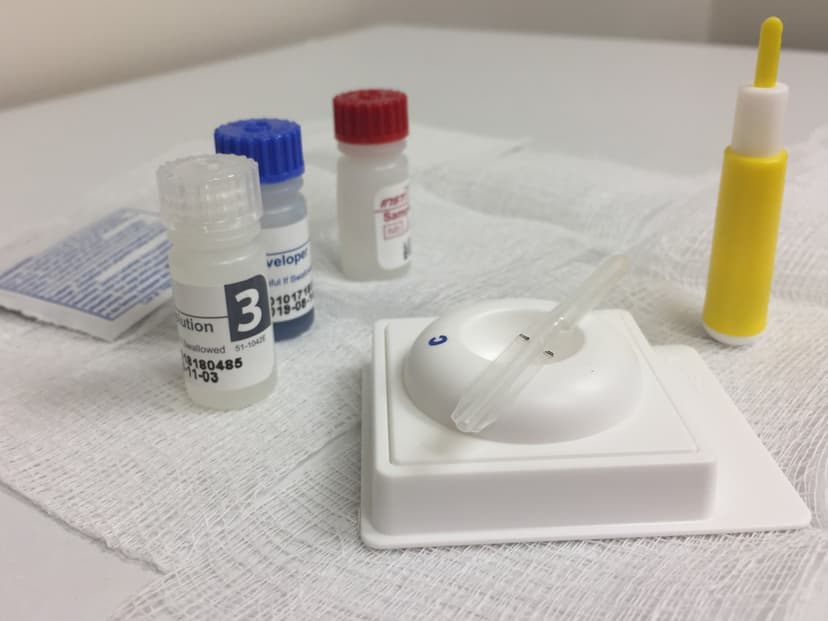
Photo: NIAID / Wikimedia Commons · CC BY 2.0
What did the study find?
The researchers used national health surveys from Malawi, Rwanda, Zambia and Zimbabwe covering boys and men aged 15 to 49 who said they had ever had sex. Each country had one survey before 2008 and another between 2015 and 2020, either side of its push to expand voluntary medical male circumcision, or VMMC, for HIV prevention. A different group of men took part each time.1
Altogether, the analysis covered 41,094 boys and men. BMC Public Health published it on Sept. 29, 2026.1
- Circumcision: Malawi, Rwanda and Zambia all saw a statistically significant increase in the share of circumcised men. Zimbabwe barely moved, going from 11.9% to 12.8%.1 In Rwanda, the preprint reports, the share climbed from 11.3% in 2005 to 49.0% in 2019-2020.2
- Reported infections: taking all four countries together, the share of men who reported an STI diagnosis, or a genital sore, ulcer or discharge, in the previous 12 months rose from 5.3% to 8.2%.1
- Before and after: once the researchers adjusted for other factors, men in the later surveys had roughly 52% higher odds of reporting an STI than men in the earlier ones (adjusted odds ratio 1.52; 95% confidence interval 1.33 to 1.74).1
- Circumcised vs uncircumcised men: the researchers found no statistically significant gap between the two groups in reported STIs (adjusted odds ratio 1.03; 95% confidence interval 0.92 to 1.17).1
- Medically circumcised men only: in a separate check, using the later surveys only and leaving out men circumcised by traditional practitioners, medically circumcised men had slightly lower, but not statistically significant, odds of reporting an STI (adjusted odds ratio 0.92; 95% confidence interval 0.78 to 1.07). This is from the preprint.2
Did the programs cause the rise?
The study can't answer that. It compares two sets of surveys taken years apart, so it can't prove the programs drove the increase or tell us what infection levels would have looked like without them. The authors point to "the lack of a robust counterfactual scenario" as the main limit of the before-and-after comparison.2
Does this mean circumcision doesn't protect against STIs?
The authors stop short of that claim. In the preprint's discussion they write: "However, VMMC clearly provides important benefits for the prevention of HIV and some specific STIs, including among women (e.g. HPV-associated cervical cancer)."2 In the published abstract, they report "limited evidence for a protective population-level association" between VMMC scale-up and self-reported STIs in East and Southern Africa.1 The preprint adds that "it cannot be entirely excluded that scaling-up VMMC programmes had a protective effect on the prevalence of specific STIs."2
The preprint's introduction notes that the World Health Organization and UNAIDS recommended VMMC as part of HIV prevention in 2007.2 It also cites a recent review that found convincing evidence that circumcision protects against herpes simplex virus type 2, human papillomavirus and syphilis, while evidence for chlamydia and gonorrhea is more limited and conflicting.2
Why might reported infections have risen?
In the preprint, the researchers suggested some possible explanations. They offered these as ideas rather than findings:2
- Wider trends: STIs may have risen for reasons the surveys didn't measure. STI reports rose among both circumcised and uncircumcised men.
- Too little change: the increase in circumcision may have been too small to slow that rise.
- More testing: the sexual health services that come with circumcision programs may have found infections that would otherwise have gone undiagnosed. The authors call this less likely; a check using only reported diagnoses gave similar results.
- Behavior change: circumcised men may have changed their sexual behavior. The authors list this as another possible explanation. They note that a 2017 study of surveys from 10 countries in eastern and southern Africa found no sign of it, and that if it were the main cause, circumcised and uncircumcised men would probably have differed, which they did not find.
What are the study's limits?
- Self-reported: the figures come from what men told survey workers, with no lab tests. That likely left out infections without symptoms and may have counted symptoms that weren't infections.2
- Before and after: the design can't separate the programs from everything else that changed over the same years.1, 2
- Types of infection: the surveys can't tell which infections men had, so the study can't say whether circumcision affects some STIs differently from others.2
- Zimbabwe: circumcision coverage barely changed there, and the change wasn't statistically significant.1
What did the authors recommend?
They call for sexual health services built around men's needs, with fewer barriers to care, and for VMMC to be folded into broader sexual health services.1 The preprint also calls for future studies with stronger designs that can tell different STIs apart.2
What isn't known yet?
- Whether lab-confirmed infection rates follow the same pattern.
- What the final, edited version of the paper will say. BMC says this early version will be replaced by the final Version of Record.1
What it means
In these four countries, men reported more STIs after circumcision programs expanded, and circumcised men reported them about as often as uncircumcised men. In the preprint, the authors say VMMC programs alone are not enough to address men's STI burden, while noting that a protective effect against specific STIs can't be ruled out. They continue to credit VMMC with preventing HIV and some STIs.1, 2
Original reports and sources (2)
- Vanhamel J, Smekens T, Ameyan W, Choko A, Mavhu W, Phiri MM, Hensen B. "Examining the association between male circumcision and the prevalence of self-reported sexually transmitted infections among adolescent boys and men (15-49 years old) in Malawi, Rwanda, Zambia and Zimbabwe." BMC Public Health, published September 29, 2026 (early version, subject to further edits). https://doi.org/10.1186/s12889-026-29699-7 (accessed Nov 3, 2026)
- Vanhamel J, et al. Same title, preprint. medRxiv, doi 10.1101/2025.10.02.25337212, posted October 5, 2025. https://www.medrxiv.org/content/10.1101/2025.10.02.25337212v1.full (accessed Nov 3, 2026)
See something wrong? Report an error · How we correct pages