Is circumcision linked to autism? What a US study found
A study of 2,771 boys found no link between newborn circumcision and autism after adjustment. What it, a Danish study and Kennedy's Tylenol claim show.
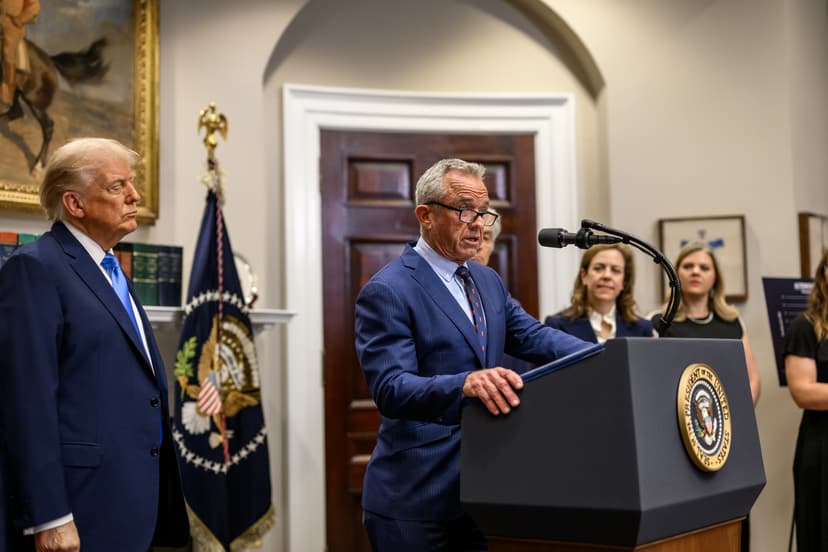
Photo: Molly Riley / The White House
A US study of 2,771 boys found no link between circumcision in the hospital soon after birth and a later diagnosis of autism.
The study, published August 3 in JAMA Pediatrics, included boys born from 2003 to 2023 at 14 sites in the National Institutes of Health-funded Environmental Influences on Child Health Outcomes, or ECHO, program.
"We observed no association between circumcision and autism in boys, but it remains important to evaluate the safety of common medical procedures," Monica McGrath, the study's lead author and a Johns Hopkins research professor, said in a news release.
Autism was diagnosed in 108 of the 1,840 circumcised boys (6%) and in 84 of the 931 uncircumcised boys (9%). After the researchers accounted for the mother's education, the parents' ages, family history of autism and region, the difference was not statistically significant. Two questionnaires that measure autism-related traits and behaviors also showed no overall link after adjustment.

The Tylenol claim
Health and Human Services Secretary Robert F. Kennedy Jr. raised the question at a Cabinet meeting on October 9, 2025. He said two studies showed that children circumcised early had double the rate of autism, and that it was "highly likely" because they were given Tylenol. He added that none of it was conclusive.
A day later he wrote on X that the pattern was "best explained by acetaminophen exposure, not circumcision itself," pointing to a review posted online in August 2025. Acetaminophen is the active ingredient in Tylenol. The review looked at 64 earlier papers and presented no new data from patients. It had not been peer-reviewed when Kennedy cited it; a journal version with fewer authors was published on October 26, 2025, labeled "open peer review."
The new study also looked at how often acetaminophen was recorded. Among 877 circumcised boys with procedure records, 31 (4%) received it during or right after the procedure, and about 7% of circumcised boys received it within 30 days of birth. That was too uncommon to test as a pathway between circumcision and autism, the researchers said, and their results were similar when children with recorded acetaminophen use were left out. Use outside hospital records was not captured, and the finding did not establish whether Tylenol plays a part.
Rabbi Nechemia Markovits, a fifth-generation certified mohel and circumcision specialist in Brooklyn who has performed circumcisions for nearly 40 years, described his own practice to the New York Post in October 2025.
He said: "The procedure is quick and well-tolerated."
"I place a light gauze with Vaseline to protect the area, and if there's any mild discomfort, parents can use a gentle topical spray on the first day. Every family has direct access to me afterward through WhatsApp, and I guide them personally through the healing process until everything is completely healed."
"I've never had newborns use Tylenol," he said, adding: "My focus is simply on providing safe, comfortable, and natural healing for each patient."
For older children, he said a proper dose could ease short-term soreness.
The earlier studies
The review Kennedy cited drew on two earlier studies. One, a 2015 Danish study, followed 342,877 boys born from 1994 to 2003. Of the 3,347 who were circumcised, 57 were diagnosed with autism. Circumcised boys had a 46% higher rate of autism diagnosis before age 10. The doubled figure applied to a narrower diagnosis, infantile autism, before age 5; no significant link appeared at ages 5 to 9.
That study had no data on painkillers. Its authors suggested pain or stress from the procedure as a possible explanation, and said data limitations likely made their estimates conservative. The study did not include circumcisions done by religious circumcisers in private settings.
The other study, from 2013, compared circumcision and autism rates across countries and US states. It found higher autism rates where circumcision was more common, but it had no information on what medicine any child received and cannot show cause.
Discussing the 2013 and 2015 studies in October 2025, University of Pennsylvania biostatistician Jeffrey S. Morris told FactCheck.org: "I don't think either study provides any substantial evidence that [acetaminophen] use increases risk of autism."
David S. Mandell, a psychiatry professor at the same university, said of the Danish study: "This study didn't examine use of acetaminophen at all."
The new study has limits of its own. It covered circumcisions done in hospitals on newborns, and its authors said the results may not apply to circumcisions done outside hospitals or later in childhood. Its boys did not represent all US boys. Finding no significant link is not proof that there is no effect, and one practitioner's experience cannot establish population-wide risk.
None of the three studies shows that Tylenol given after circumcision causes autism.
On Circumpedia: Newborn circumcision · Who performs newborn and child circumcision
See something wrong? Report an error · How we correct pages