What is the foreskin? Purpose, retraction and care
 Medically reviewed by Dr Mazen Abu Alnasr, MD, General Surgeon (Saudi Board of General Surgery)Reviewed Nov 17, 2026
Short answer
The foreskin (prepuce) is the fold of skin that covers the head of the penis (glans).1, 2 Its outer layer is ordinary skin; its inner layer is a moist lining.2, 4 It covers and protects the head of the penis.2, 3 At birth it is stuck to the head and doesn't pull back; it loosens slowly during childhood, at different ages in different boys.3, 4R1 Circumcision removes it.5R2
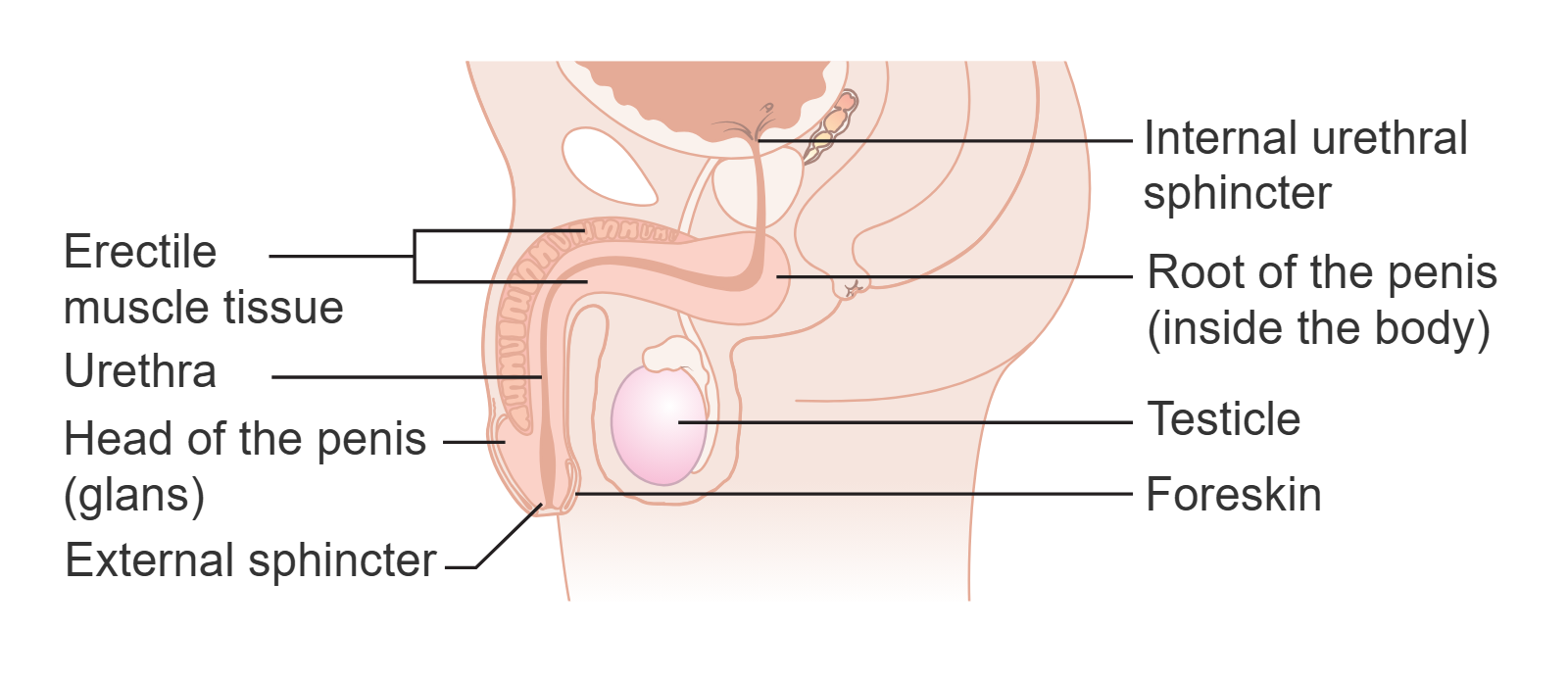
Drawing: Cancer Research UK / Wikimedia Commons · CC BY-SA 4.0
Key takeaways
- What it is: a double layer of skin over the head of the penis, joined underneath by a small band (frenulum).1R3
- What it does: covers and protects the head of the penis and helps keep its surface moist.2, 3
- Babies and boys: the foreskin is normally tight and attached; never force it back.3, 4R1
- Men: wash under it every day with warm water.6
On this page
What is the foreskin?
The foreskin, also called the prepuce, is the skin that covers the head of the penis (glans).1 Its outer layer is skin like the rest of the penis. Its inner layer is a moist lining (mucous membrane).2, 4 Foreskins vary in length and in how much of the head they cover; this is normal.7
On the underside, a small band of skin (the frenulum) joins the foreskin to the head of the penis.1R3
Circumcised means the foreskin has been removed; uncircumcised means it is still there.5R2
What does the foreskin do?
The foreskin covers and protects the head of the penis.2, 3 In babies, it protects the end of the penis from rubbing against wet or dirty diapers.3
Its moist inner lining helps keep the surface of the head soft and moist.2
Whether removing the foreskin changes sexual feeling or function is studied and debated; see Adult circumcision benefits and risks.
How does the foreskin change with age?
| Age | What's normal |
|---|---|
| At birth | Stuck to the head of the penis; it doesn't pull back4R1 |
| Toddler and young child | The attachments start to break down after 1 to 2 years, at different rates in different children4R1 |
| School age | Many boys' foreskins pull back by 10; some not until later4R1 |
| Teen | Sheffield Children's: 99 in 100 boys by 164R1 |
| Adult | Usually pulls back easily; a foreskin that won't is called phimosis1, 8R4 |
Health bodies give different ages for when the foreskin pulls back; all say not to force it.R1 For the full routine by age, see How to clean an uncircumcised baby or boy, by age.
Ballooning when a young boy urinates is normal: urine caught under the foreskin helps peel it away from the head.4R1
What does foreskin retraction mean?
Retraction means pulling the foreskin back to uncover the head of the penis.2, 4 In boys it becomes possible on its own as the foreskin separates; it should never be hurried or forced.2R1 Once it moves, a boy can learn to do it himself at bath time.2R1 After pulling it back, always return the foreskin over the head; one that stays stuck behind is an emergency (see below).R1
How do you clean the foreskin?
Babies and young boys: wash the outside only, with warm water; don't pull the foreskin back.3R1
Older boys and men: once the foreskin pulls back,
- Daily: gently pull it back only as far as it goes comfortably, never forcing it, and wash underneath with warm water.3, 6
- Soap: a gentle, unscented soap is fine; rinse it off well, as too much can irritate.6R4
- Afterward: always pull the foreskin forward again over the head.3R1
In teens and men, if the foreskin is too tight to pull back, or pulling it back hurts or splits it, don't force it: see a doctor.3, 6
What is smegma?
Smegma is a white or yellowish substance, mostly shed skin cells, that collects under the foreskin.3, 4 Some is normal.6 If it builds up, it can smell and can lead to infection, so wash under the foreskin regularly.3, 6
In boys, white lumps of smegma ("smegma pearls") are normal as the foreskin separates; don't squeeze them out.R1
What problems can affect the foreskin?
- Tight foreskin (phimosis): the foreskin won't pull back over the head. Normal in babies and young boys; in men, see Phimosis in adults.1R4
- Foreskin stuck behind the head (paraphimosis): a pulled-back foreskin that won't go back, with swelling and pain. This is an emergency.R4R1
- Inflamed head and foreskin (balanitis, balanoposthitis): redness, swelling, soreness, itching or discharge.3, 5R4
- Short frenulum: can cause pain or tearing during erections or sex; see Short or torn frenulum.R3
- Lichen sclerosus: a long-term skin condition that can scar the foreskin and make it tight.R4
When to call your provider
- Call 911 now or go to the emergency department: a foreskin pulled back and stuck behind the head of the penis; being unable to urinate at all; a torn frenulum still bleeding heavily after 15 minutes of firm pressure.R1R3
- Call your provider today: pain, redness, swelling or pus from the foreskin; red foreskin with a fever; pain or trouble urinating.3R1
- Normal: keep watching: a tight, attached foreskin in a baby or young boy; ballooning when he urinates with a normal stream; white smegma lumps in boys.R1
Questions to ask
For a baby or boy:
- Is his foreskin developing normally for his age?
- How should we clean it, and when should he start pulling it back himself?
For a man:
- Is my foreskin tight, or is this normal for me?
- Could this redness or soreness be an infection or a skin condition?
- What are my options if it keeps causing problems?
The bottom line
The foreskin is a fold of skin that covers the head of the penis. In babies it is attached and tight, and it loosens slowly with age; forcing it back can hurt and scar. Once it moves, washing underneath with warm water is the usual care. Ask a doctor about pain, swelling or a foreskin that won't move.
Sources (8)
- Sam P. "Anatomy, Abdomen and Pelvis, Penis." StatPearls. 2023. https://www.statpearls.com/ArticleLibrary/viewarticle/26904 (accessed Nov 12, 2026)
- KidsHealth New Zealand (Paediatric Society of New Zealand). "How To Care For Your Child's Foreskin." Reviewed Jun 16, 2023. https://kidshealth.org.nz/foreskin-care (accessed Nov 12, 2026)
- 4skin Health, Alder Hey Children's NHS Foundation Trust (UK). "For Teenagers & Young Adults." Modified Jan 12, 2024. https://4skin-health.alderhey.nhs.uk/teenagers-young-adults/ (accessed Nov 12, 2026)
- Sheffield Children's NHS Foundation Trust (UK). "Normal penis and foreskin development." Published May 9, 2023; updated Jan 5, 2024. https://library.sheffieldchildrens.nhs.uk/normal-penis-and-foreskin-development/ (accessed Nov 12, 2026)
- University of Utah Health. "Circumcision as an adult, circumcised vs uncircumcised, phimosis and paraphimosis treatment." Modified Sep 15, 2026. https://healthcare.utah.edu/mens-health/treatments/circumcision-frenulotomy (accessed Nov 12, 2026)
- healthdirect Australia. "Penis care." Last reviewed Nov 2025. https://www.healthdirect.gov.au/penis-care (accessed Nov 12, 2026)
- Dr Mazen Abu Alnasr, Circumpedia medical reviewer, written statement to Circumpedia, Nov 16, 2026.
- McPhee AS, Stormont G, McKay AC. "Phimosis." StatPearls, NCBI Bookshelf. Updated Aug 8, 2023. https://www.ncbi.nlm.nih.gov/books/NBK525972/ (accessed Oct 26, 2026)
Reviewer citations
Named by the reviewing doctor; not opened or verified by Circumpedia.
- R1. Dr Sofia Boilini approved this wording on Circumpedia's page "How to clean an uncircumcised baby or boy, by age" (/babies-children/uncircumcised-penis-care), Nov 4, 2026; its sources are listed there.
- R2. Dr Mazen Abu Alnasr approved this wording on Circumpedia's page "What is circumcision?" (/basics/what-is-circumcision), Nov 4, 2026; its sources are listed there.
- R3. Dr Mazen Abu Alnasr approved this wording on Circumpedia's page "Short or torn frenulum: healing and frenuloplasty" (/adults/frenulum), Oct 30, 2026; its sources are listed there.
- R4. Dr Mazen Abu Alnasr approved this wording on Circumpedia's page "Phimosis in adults: causes, treatment, circumcision" (/adults/phimosis), Oct 30, 2026; its sources are listed there.
See something wrong? Report an error · How we correct pages · How we make our pages