Circumcised vs uncircumcised penis: looks, care, health
 Medically reviewed by Dr Mazen Abu Alnasr, MD, General Surgeon (Saudi Board of General Surgery)Reviewed Nov 17, 2026
Short answer
Circumcised means the foreskin has been removed; uncircumcised means it is still there.R1 Both are normal. The main differences are in how the penis looks, how it is washed, and some health risks: circumcised males get fewer urinary tract infections, most clearly in infancy, and in trials in Africa men had a lower risk of HIV from vaginal sex.1 Circumcision also has its own risks, such as pain, bleeding and infection.R4 Most studies don't show less sexual pleasure.1, 2 What matters differs by age.
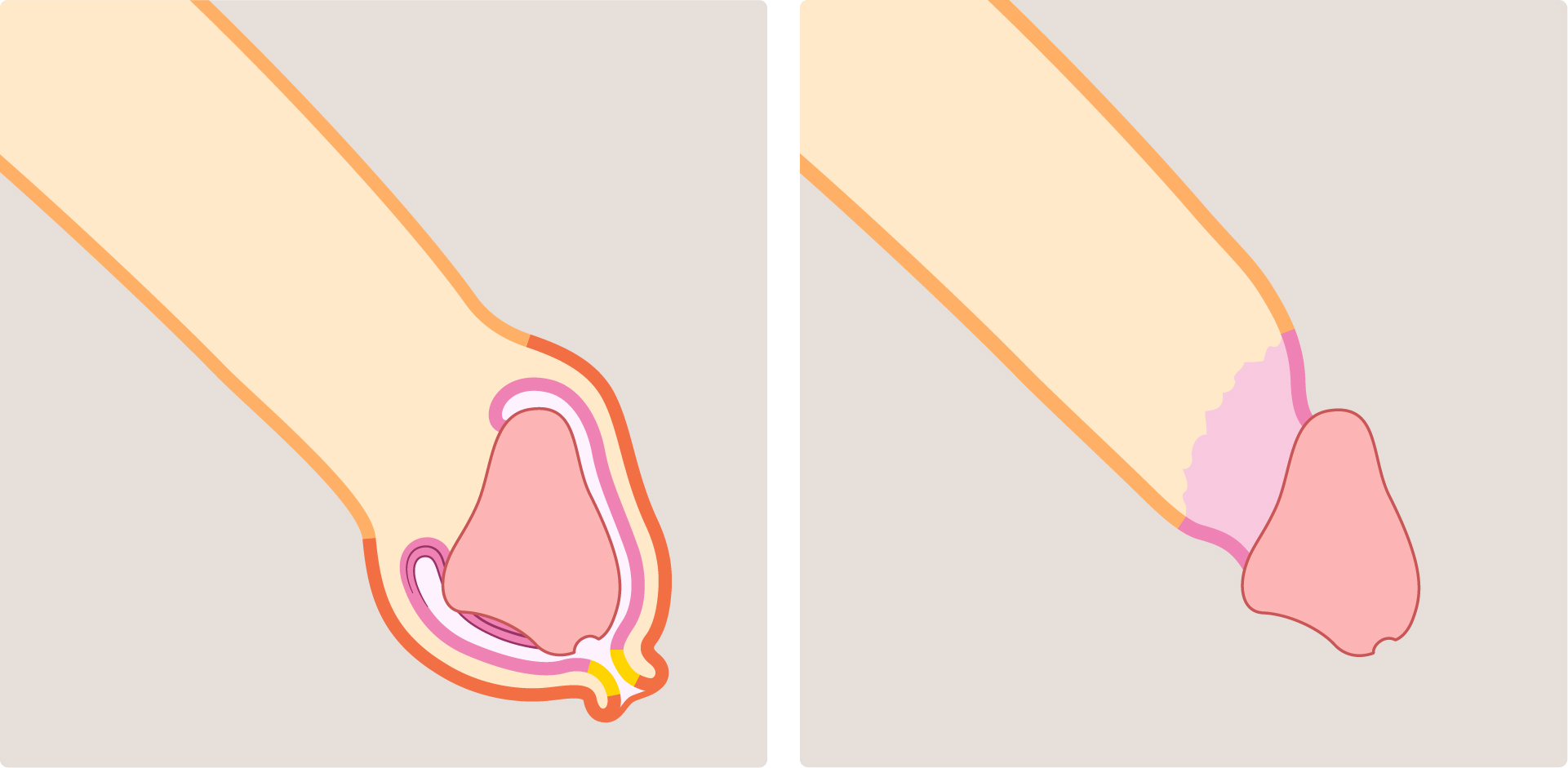
Drawing: Guido4 / Wikimedia Commons, two panels cropped and placed side by side · CC BY-SA 4.0
Key takeaways
- Look: with a foreskin, the head of the penis is covered when soft; without one, it shows.3
- Washing: both need regular, gentle washing; a male with a foreskin also washes underneath it once it pulls back.3, 4
- Health: circumcision lowers some infection risks but doesn't remove them; many uncircumcised males never have these problems.1, 3
- Sex: on average, little or no change in satisfaction; the foreskin's own sensation is lost.1
- Babies: a baby's foreskin is normally tight and attached; it is never pulled back by force.R2
On this page
At a glance
| Circumcised | Uncircumcised | |
|---|---|---|
| Foreskin | RemovedR1 | Still thereR1 |
| Head of the penis when soft | Shows3 | Covered3 |
| Washing (men) | Wash the head and shaft3, 4 | Pull the foreskin back, rinse underneath, pull it forward3–5 |
| Washing (babies) | Follow the healing care, then wash as normalR3 | Outside only; never force it backR2 |
| Urinary infections | Fewer, most clearly in infancy1 | More common1, 3 |
| HIV from vaginal sex (men) | Lower risk, not removed1 | Not lowered1 |
| Sexual satisfaction | Little or no change, on average; the foreskin's own sensation is lost1 | Foreskin sensation kept1 |
| Risks of the procedure | Pain, bleeding, infection and othersR4 | None (no procedure) |
| Foreskin problems | Phimosis and paraphimosis very unlikely; balanitis less likely3 | Can happen; a foreskin that doesn't yet pull back is usually normal in children3R2 |
Foreskin
Head of the penis when soft
Washing (men)
Washing (babies)
Urinary infections
HIV from vaginal sex (men)
Sexual satisfaction
Risks of the procedure
- Circumcised
- Pain, bleeding, infection and othersR4
- Uncircumcised
- None (no procedure)
Foreskin problems
What is the difference?
The foreskin is the skin that covers the head of the penis, and circumcision is its removal.R1 In a circumcised penis the head (glans) is uncovered; in an uncircumcised penis the foreskin covers it; it can be pulled back by hand once it is loose.3
Does one look different?
Yes, mainly when the penis is soft: with a foreskin, the head is covered; without one, it shows.3 Circumcision is not intended to change the length of the shaft of the penis; it removes the foreskin, not erectile tissue.2
Is one cleaner?
Both need regular, gentle washing. Circumcision can make cleaning easier, and an uncircumcised penis can also be kept clean: a circumcised penis isn't necessarily more hygienic; it comes down to washing habits.3, 4
- Same basics for both: wash every day with warm water; gentle soap is fine, but too much can irritate.4, 5
- With a foreskin (once it pulls back): gently pull it back, rinse the head and the inside of the foreskin, then pull the foreskin forward over the head.4, 5
- Smegma: some thick, white matter under the foreskin is normal; a build-up can smell and can irritate the skin.4, 5
Is there a health difference?
Yes, for some conditions, and circumcision lowers these risks without removing them:1
- Urinary infections: circumcised males get fewer urinary tract infections, most clearly in infancy; the CDC also reports a lower risk in men over 16.R41
- HIV: in trials in Africa, circumcision lowered men's risk of getting HIV from vaginal sex, but did not remove it.R41
- Other sexually transmitted infections: circumcised men were less likely to get genital herpes (HSV-2) and high-risk types of human papillomavirus (HPV), although circumcision doesn't fully prevent either infection.R41
- Penile cancer: cancer of the penis is rare. Invasive cancer of the penis is less common in men who were circumcised as children or teenagers.R46
- Foreskin problems: phimosis (a tight foreskin), paraphimosis (a foreskin stuck behind the head) and recurrent balanitis (inflammation of the head) are less likely after circumcision.3 A foreskin that does not yet pull back is usually normal in children.R2
Many uncircumcised males never have any of these problems.3 Condoms, fewer partners and PrEP still matter, whether you're circumcised or not.R41
Circumcision has its own risks, such as pain, bleeding and infection: see Adult circumcision benefits and risks.R4
Does it change sex or sensation?
Most studies don't show less sexual pleasure or satisfaction.R41, 2 On average, men circumcised as adults report little or no change in sexual satisfaction or function. Men who enjoy the feel of the foreskin during sex lose that sensation.R41 A lasting change in the feeling of the head of the penis is common; UK urologists describe it as altered or reduced.R47
Babies and boys (birth to 17)
- Uncircumcised: in the first year, clean only the outside; don't pull the foreskin back.R2 The foreskin loosens on its own as boys get older; some can't pull it back until age 10 or later, and that's normal.R2 Ballooning when he urinates and white lumps (smegma) are normal.R2
- Circumcised: healing and care after a newborn circumcision are on Newborn circumcision.R3
- The decision: for a newborn, the decision is the parents', weighing religious, cultural and personal reasons with the medical benefits and risks.R1
Full care by age: How to clean an uncircumcised baby or boy, by age.
Men (18 and over)
An adult can make the decision for himself.R41 Men choose circumcision for medical, religious, cultural and personal reasons, most often a tight foreskin that won't pull back.R1 See Why adults get circumcised and Circumcision in adults.
When to call
Emergency: go to the emergency department
- A foreskin pulled back and stuck behind the head of the penis, with swelling and pain (paraphimosis)R2
- Can't urinate at allR2
Call your provider today
- Red, swollen or painful foreskin or head of the penis, or pusR2
- Pain, a painful or tight scar, infections that keep coming back, or trouble urinating, circumcised or not3, 4
Normal: keep watching
Questions to ask
For a baby: Is his foreskin developing normally? How do we wash it at his age? If we're thinking about circumcision, what are the benefits and risks for him?
For a man: Is my foreskin normal for my age? How should I wash under it? Would circumcision change anything for my health, and what are its risks?
The bottom line
Circumcised and uncircumcised penises are both normal. They differ in look, in washing, and in some infection risks; on average, sex and satisfaction change little. The questions that matter differ for a baby and for a man.
Sources (7)
- US Centers for Disease Control and Prevention (CDC). "Information for Providers to Share with Male Patients and Parents Regarding Male Circumcision and the Prevention of HIV Infection, Sexually Transmitted Infections, and other Health Outcomes." Aug 22, 2018. https://stacks.cdc.gov/view/cdc/58456 (accessed Nov 8, 2026)
- University of Utah Health. "Circumcision as an adult, circumcised vs uncircumcised, phimosis and paraphimosis treatment." Published Apr 6, 2021, modified Sep 15, 2026. https://healthcare.utah.edu/mens-health/treatments/circumcision-frenulotomy (accessed Nov 10, 2026)
- Healthy Male (Australia; funded by the Australian Government). "Circumcised vs uncircumcised: What's the difference?" Undated. https://healthymale.org.au/health-article/circumcised-vs-uncircumcised-whats-difference (accessed Nov 11, 2026)
- healthdirect Australia. "Penis care." Last reviewed Nov 2025. https://www.healthdirect.gov.au/penis-care (accessed Nov 11, 2026)
- International Society for Sexual Medicine (ISSM). "How should an uncircumcised man wash his penis?" Feb 10, 2014. https://www.issm.info/sexual-health-qa/how-should-an-uncircumcised-man-wash-his-penis/ (accessed Nov 10, 2026)
- Larke N, et al. "Male circumcision and penile cancer: a systematic review and meta-analysis." 2011. https://pmc.ncbi.nlm.nih.gov/articles/PMC3139859 (accessed Nov 8, 2026)
- British Association of Urological Surgeons (BAUS). "Complete removal of the foreskin (circumcision)," patient leaflet A24/077. June 2024. https://www.baus.org.uk/_userfiles/pages/files/Patients/Leaflets/Circumcision.pdf (accessed Oct 26, 2026)
Reviewer citations
Named by the reviewing doctor; not opened or verified by Circumpedia.
- R1. Dr Mazen Abu Alnasr approved this wording on Circumpedia's page "What is circumcision?" (/basics/what-is-circumcision), Nov 4, 2026; its sources are listed there.
- R2. Dr Sofia Boilini approved this wording on Circumpedia's page "How to clean an uncircumcised baby or boy, by age" (/babies-children/uncircumcised-penis-care), Nov 4, 2026; its sources are listed there.
- R3. Circumpedia, "Newborn circumcision" (/babies-children/newborn-circumcision), medically reviewed by Dr Aslı Özbayoğlu, Nov 1, 2026; healing and care are covered there.
- R4. Dr Mazen Abu Alnasr approved this wording on Circumpedia's page "Adult circumcision benefits and risks" (/adults/benefits-and-risks), Nov 8, 2026; its sources are listed there.
See something wrong? Report an error · How we correct pages · How we make our pages